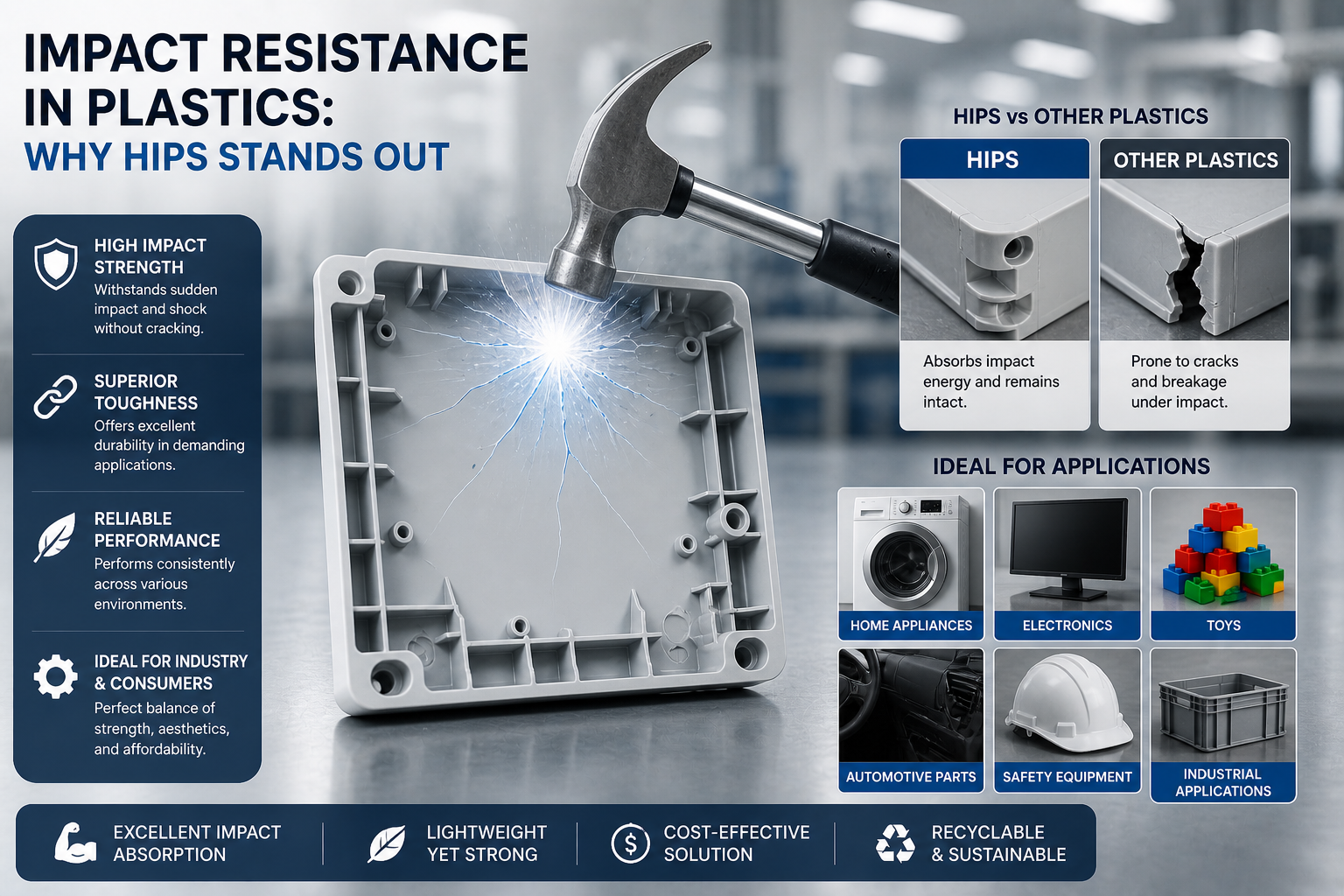
In this blog, Supreme Petrochem examines a property at the heart of durable plastic manufacturing: impact resistance plastics and specifically why high impact polystyrene consistently stands out as the preferred specification wherever products must withstand real-world mechanical stress. As India’s largest manufacturer of polystyrene with a capacity of 300,000 TPA at our Nagothane facility and over 50% of the domestic market share, Supreme Petrochem brings three decades of manufacturing experience to this topic. We produce a wide range of high-impact polystyrene grades, each engineered to deliver precisely the combination of HIPS impact strength, gloss, dimensional stability, and processability that different industrial and consumer applications demand.
Impact resistance is not simply a measure of hardness; it measures how well a material absorbs and dissipates energy during sudden shock without fracturing. High-impact polystyrene achieves exceptional performance through the addition of polybutadiene rubber as a polystyrene impact modifier, transforming standard polystyrene from a brittle, glassy material into a rubber-toughened plastic suited to electronics housings, household appliances, food packaging, toys, and automotive components. This blog explains the science behind that transformation and how Supreme Petrochem’s HIPS grades translate it into practical, durable plastic manufacturing solutions.
Why Standard Polystyrene Lacks Impact Resistance — and How Rubber Modification Changes That
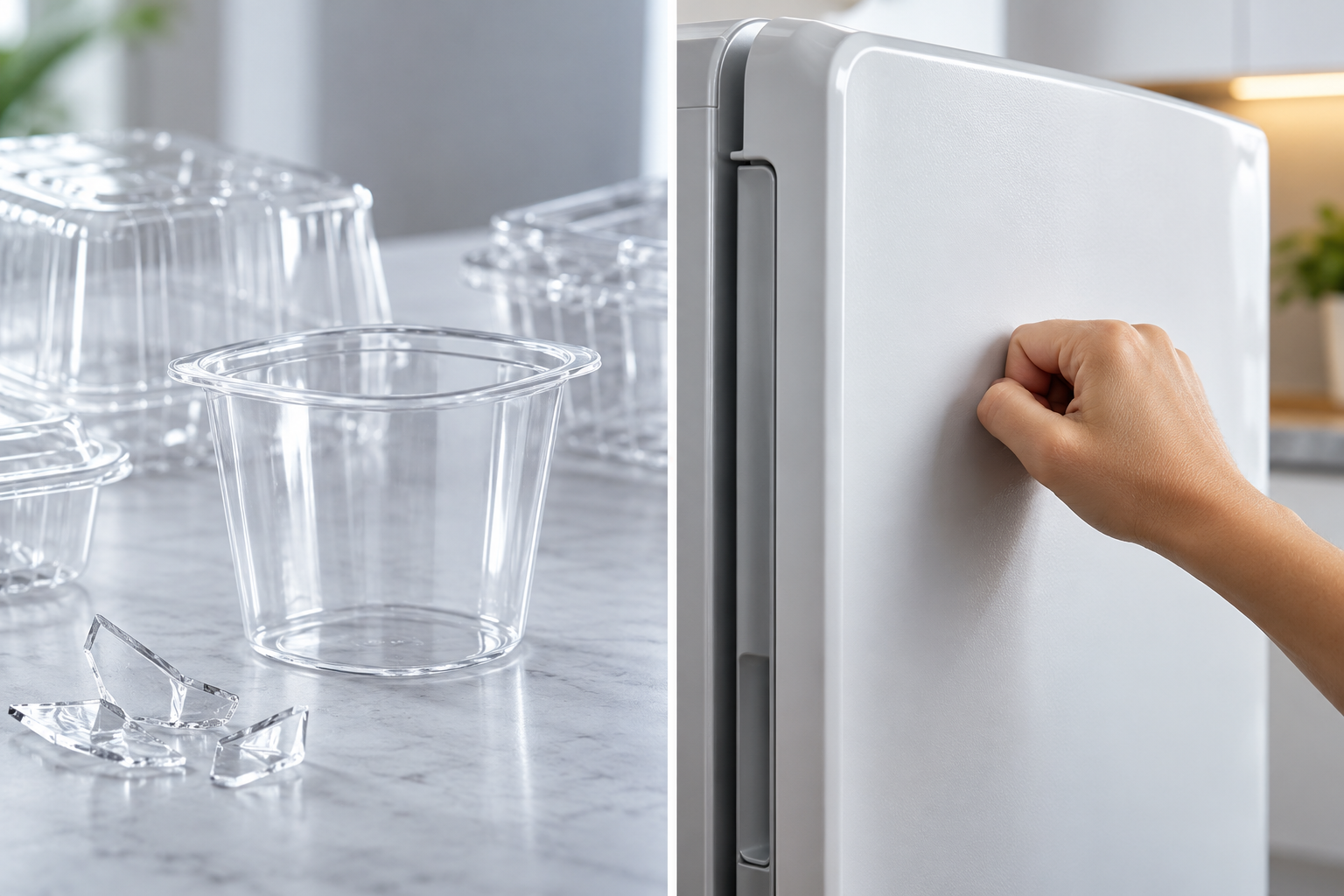
Standard polystyrene (GPPS) is a single-phase, amorphous homopolymer entirely uniform at the microscopic level with no secondary phases. This uniformity gives GPPS its optical clarity, but also makes it brittle: under sudden shock, stress concentrates at surface flaws and propagates catastrophically, resulting in brittle fracture with minimal deformation. There is no mechanism to absorb or redirect impact energy.
The solution is the use of polybutadiene rubber as a polystyrene impact modifier. During manufacturing, rubber dissolves in styrene monomer before polymerisation. As polymerisation proceeds, polystyrene and polybutadiene become chemically incompatible, leading to phase separation. The rubber forms discrete microscopic particles (1–10 micrometres) permanently embedded throughout the polystyrene matrix at 5–12% by weight. When impact occurs, these rubber particles deform, absorbing energy and arresting micro-crack propagation before cracks can run through the component. The result is a rubber-toughened plastic that deforms and absorbs stress rather than shattering, exactly what durable plastic manufacturing demands.
High Impact Polystyrene Properties That Make It a Standout Impact Grade Plastic Resin
The high impact polystyrene properties that make HIPS the preferred impact grade plastic resin extend well beyond raw impact performance. HIPS impact strength is the headline benefit vastly improved resistance to sudden shock that directly translates into products surviving drops, repeated handling, and mechanical stress in service. Dimensional stability is equally important: HIPS reliably retains its shape across temperature and humidity, which is critical for precision-moulded components such as refrigerator door liners, where any post-moulding variation affects fit. Supreme Petrochem’s SH2157 grade specifically delivers excellent ESCR against blowing agents, including cyclopentane, mixed pentanes, and 141b, ensuring long-term structural integrity in refrigerator applications.
Surface quality is a commercial differentiator. Grades SH300, SH400HF, SH400M, and SH450 achieve high gloss for consumer electronics and household goods; SH2157 provides a matte finish with good printability for retail displays and signage. High-impact polystyrene also retains the excellent processability of the styrenic family (injection moulding, extrusion, thermoforming, and blow moulding using the same equipment as GPPS), accepts colour uniformly, and has a surface that suits printing, painting, and adhesive bonding, making it adaptable for decorated consumer products.
HIPS vs GPPS vs ABS: How Impact Resistance Compares
High impact polystyrene occupies a commercially critical middle ground between standard polystyrene and ABS in the impact resistance plastics spectrum:
| Property | Standard Polystyrene (GPPS) | HIPS | ABS |
| Impact Resistance | Low — brittle fracture | Good — rubber absorbs energy | Very good — higher than HIPS |
| Optical Transparency | High (glass-like) | Opaque (milky white) | Opaque |
| Tensile Strength | Higher (rigid matrix) | Moderate | High |
| Surface Gloss | High gloss (clear) | High gloss (specialist grades) | High gloss |
| Heat Distortion | Moderate | Moderate | Better than HIPS |
| Cost | Lowest | Low–moderate | Moderate–higher than HIPS |
| Ideal Use | Clear packaging, lab disposables, display items | Appliance housings, electronics, toys, refrigerator liners, packaging | Structural components, safety-critical parts, high-heat applications |
HIPS eliminates brittleness as a design constraint in most consumer and industrial applications at a cost far below that of ABS. ABS offers superior impact grade plastic resin performance, higher heat distortion, and better chemical resistance the right choice for safety-critical or structural components. Supreme Petrochem produces ABS at 70,000 TPA Phase One capacity at Nagothane via mass polymerisation (Versalis-Eni Chemicals Group licence), offering a natural upgrade path within the same supplier relationship. The practical specification guidance is straightforward: optical transparency → GPPS; good impact performance at cost → high impact polystyrene; highest impact, heat, or chemical resistance → ABS.
How HIPS Impact Strength Shapes Application Selection Across Key Sectors
Consumer electronics and office equipment: TV cabinets, monitor housings, printer casings, and computer accessories must survive manufacturing, packing, shipping, and installation. Supreme Petrochem’s SH03 grade is specifically suited to gas-assisted injection moulding of large TV cabinets; SH300 and SH450 serve the broader electrical appliance and office equipment sector.
Household appliances: Washing machines, air conditioners, and refrigerators depend on HIPS for housings, grills, and liner panels. Refrigerator liners face blowing agents during insulation foam installation, cold temperatures in service, and mechanical loads from shelving demands, all of which are met specifically by SH2157 with its excellent ESCR against cyclopentane.
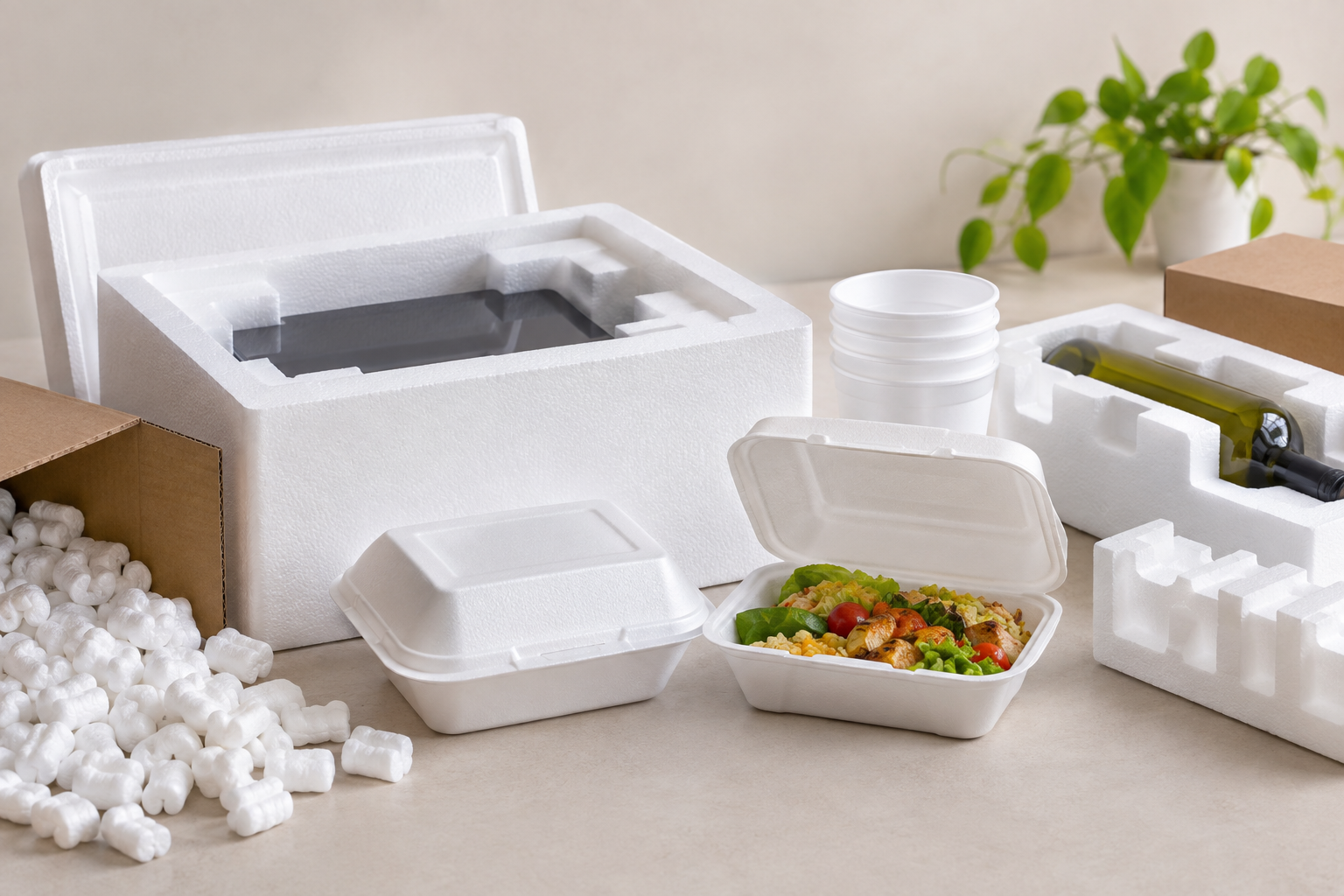
Food and dairy packaging: SH731E extrusion grade is designed for ice cream and yoghurt containers; SH2157 serves dairy packaging, frozen food packaging, and disposable medical kits. EPS from Supreme Petrochem (118,000 TPA across Nagothane and Chennai) meets the parallel need for impact-absorbing protective packaging.
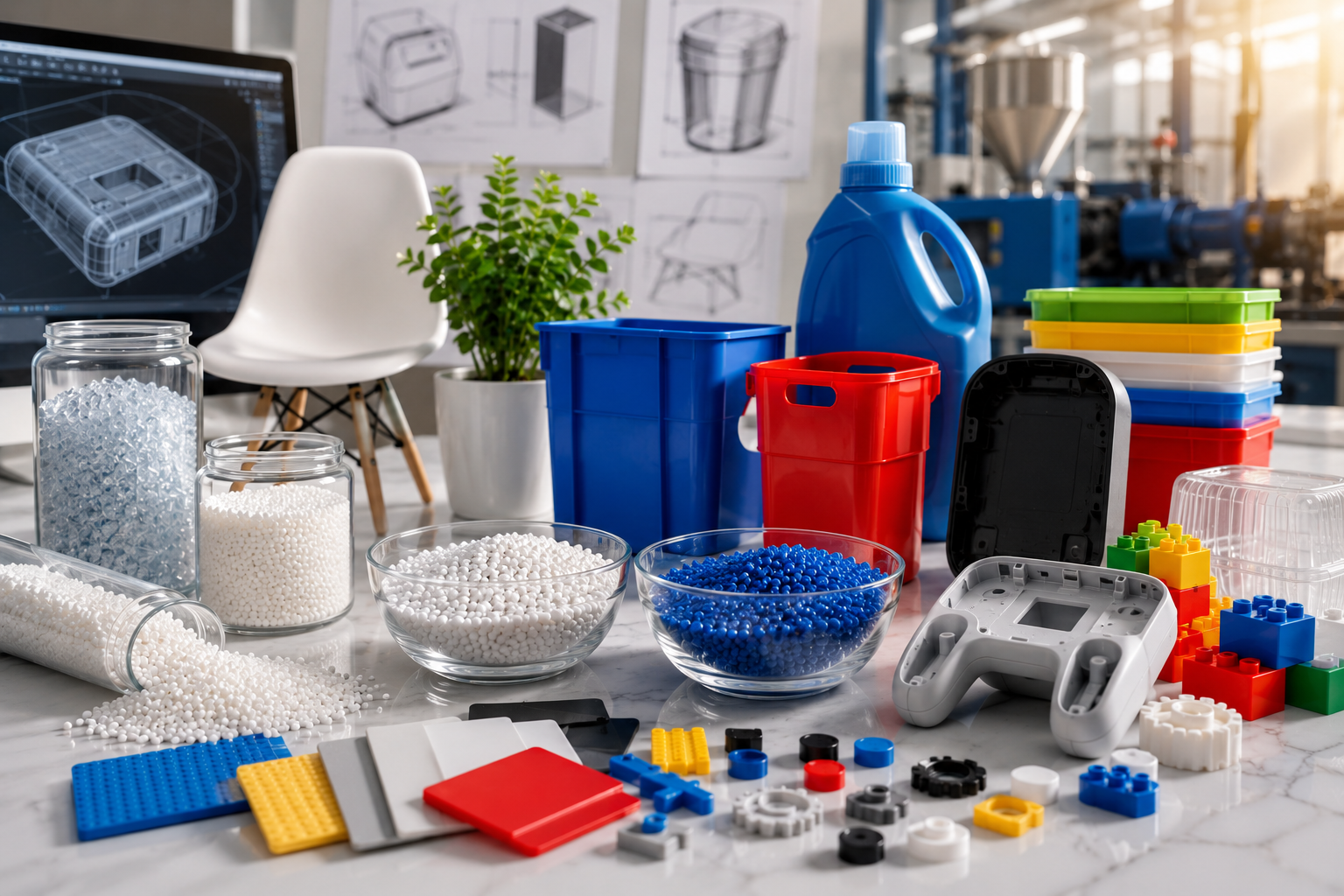
Automotive, toys, and consumer goods: Dashboard trim and interior panels benefit from HIPS impact strength and surface quality at cost efficiency. Toys subjected to the most unpredictable mechanical forces of any consumer product rely on SH03, SH300, SH400M, and SH450 for the impact resistance that prevents fracture into sharp-edged pieces.
Supreme Petrochem’s HIPS: Engineered Impact Grade Plastic Resin for Every Application
Supreme Petrochem Ltd, promoted by The Supreme Industries Ltd and the Rajan Raheja Group, operates the only international-scale styrenics complex in India at Nagothane (337 acres, Maharashtra). All HIPS grades are available in moisture-proof 25 kg and 900 kg jumbo bags. The Supreme HIPS portfolio spans eight grades covering HIPS impact strength, gloss, flow, and ESCR requirements: SH03 (high flow, TV cabinets, toys, AC grills); SH300 (improved mechanical properties and gloss, appliances, TV cabinets); SH400E (very high gloss, refrigerator liner cap layer); SH400HF (high gloss and flow, large refrigerator components); SH400M (high gloss, AC grills, household articles, stationery); SH450 (high gloss, high flow, balanced toughness); SH731E (extrusion grade, food packaging and general-purpose sheet); SH2157 (excellent ESCR, refrigerator liners, dairy and frozen food packaging, disposable medical kits, retail displays). Beyond HIPS, Supreme Petrochem’s range includes GPPS, ABS (70,000 TPA), EPS (118,000 TPA), XPS INSUboard, and Specialty Compounds and Masterbatches, a single-source styrenics partner for all durable plastic manufacturing needs.
High-impact polystyrene stands out in the impact-resistant plastics landscape by addressing the brittleness of standard polystyrene without sacrificing processability, cost efficiency, or surface quality. The polystyrene impact modifier polybutadiene rubber transforms it into a rubber-toughened plastic that delivers the HIPS impact strength, dimensional stability, and decorative flexibility demanded across electronics, appliances, packaging, automotive, and consumer goods. Supreme Petrochem’s comprehensive HIPS grade portfolio, backed by 30 years of technical expertise, ensures manufacturers can specify the exact right impact-grade plastic resin for every application.
Frequently Asked Questions
High-impact polystyrene achieves superior impact performance by incorporating polybutadiene rubber as a polystyrene impact modifier during manufacturing. Rubber particles distributed throughout the polystyrene matrix absorb and dissipate impact energy and arrest micro-crack propagation, allowing the material to deform rather than fracture. This rubber-toughened plastic structure provides dramatically better HIPS impact strength than the single-phase, glassy GPPS for all applications requiring mechanical durability.
The high-impact polystyrene properties that make it a standout impact grade plastic resin include superior HIPS impact strength over standard polystyrene, excellent dimensional stability, high surface gloss in specialist grades, outstanding ESCR against blowing agents (SH2157), compatibility with all standard thermoplastic processing routes, natural opaque colourability, and cost efficiency that makes it economically viable for high-volume durable plastic manufacturing.
High impact polystyrene is preferred over ABS when good impact resistance plastics performance is needed but ABS’s higher cost is not justified. HIPS suits consumer electronics housings, appliance components, toys, stationery, food packaging, and refrigerator liners at a lower unit cost. ABS is chosen when higher heat distortion temperature, superior impact resistance, or chemical resistance are required for structural or safety-critical components. Supreme Petrochem produces both and advises on the right specification.
High-impact polystyrene can be produced in compliance with food safety regulations. Supreme Petrochem’s SH731E grade is designed for food packaging, including ice cream and yoghurt containers. SH2157 serves dairy packaging (ice cream cups and lids), frozen food packaging, and disposable medical kits. Their HIPS impact strength and structural performance, combined with their food-safe formulation, make them a trusted specification in food, dairy, and healthcare packaging supply chains.