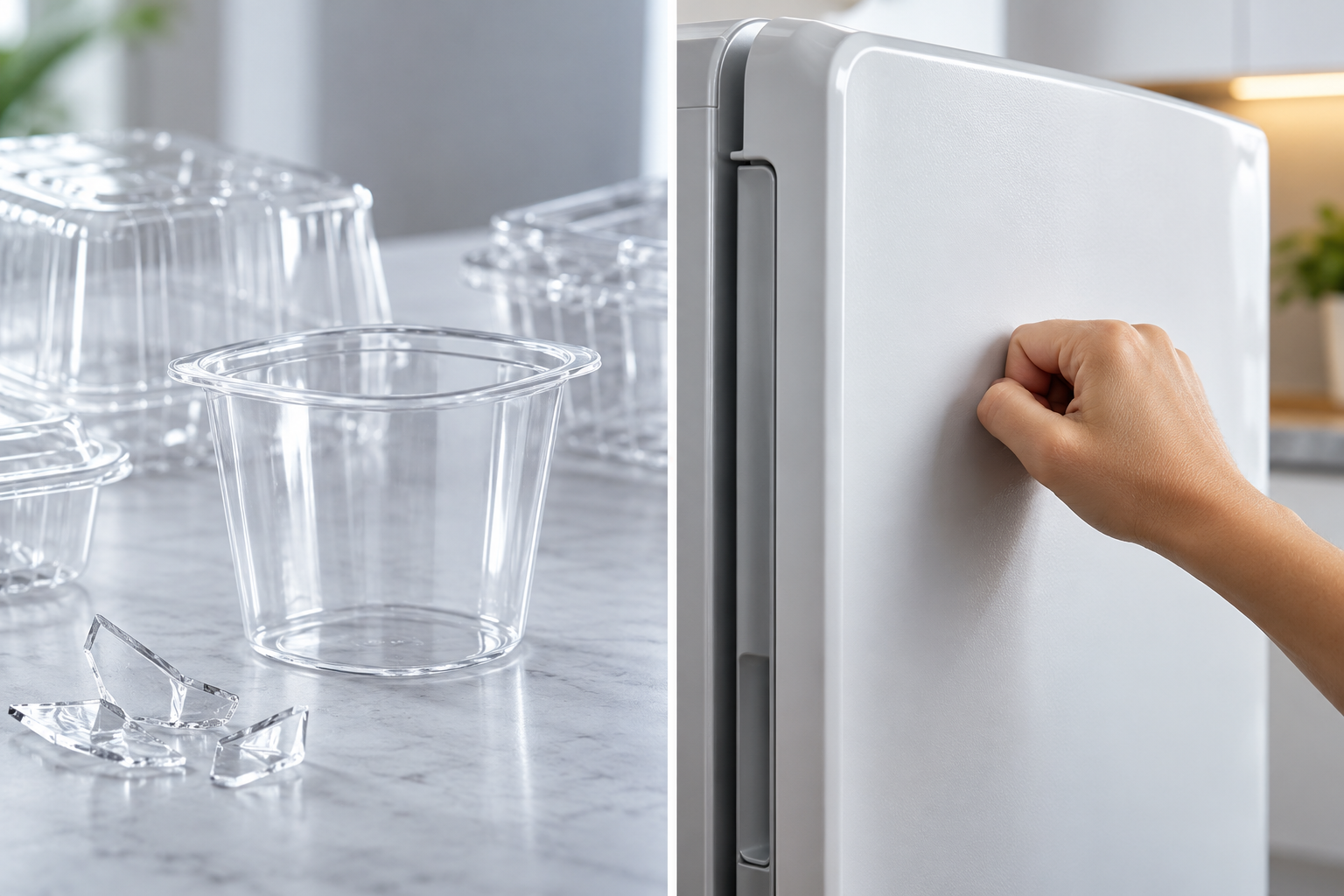
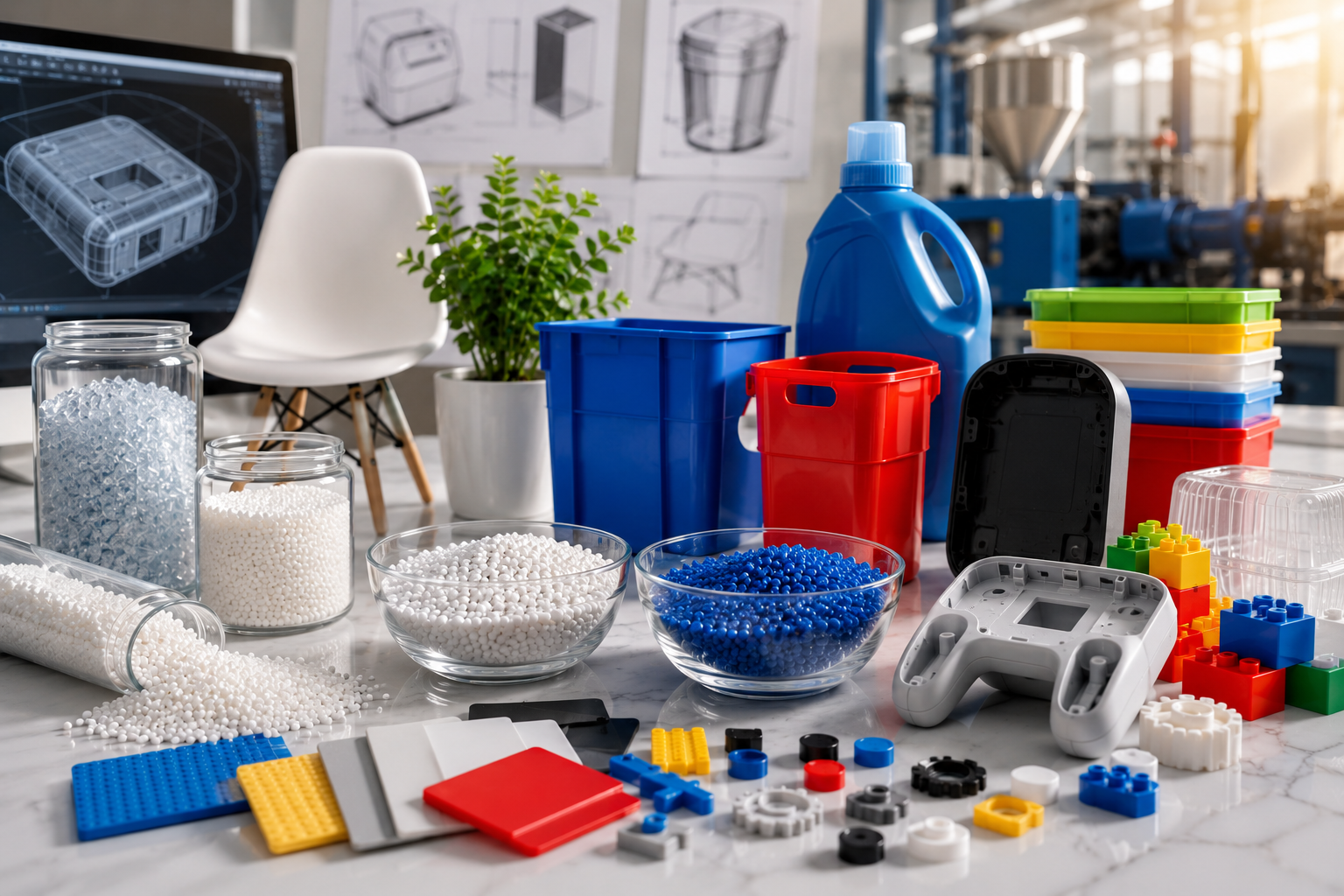
Walk into any room in a typical home, and you will find polystyrene nearby. The clear crisper tray in your refrigerator is made from general-purpose polystyrene. The tough inner liner on a washing machine door and the impact-resistant housing of your television’s remote control are both made from high-impact polystyrene. General-purpose polystyrene and high-impact polystyrene are important for modern product design, not just for their performance but also because they can be precisely matched to specific design needs. They are not just generic materials; they are engineered grades with unique mechanical properties, carefully selected for their intended roles.
In this blog, Supreme Petrochem Ltd, India’s largest polystyrene producer with an installed capacity of 300,000 TPA, examines how GPPS and HIPS each enhance product quality, consumer experience, and manufacturing efficiency. From the unique transparency of GPPS to the durability provided by HIPS, this guide uses Supreme Petrochem’s product knowledge and technical details to help designers, procurement teams, and manufacturers understand how these two grades influence the products we use daily.
What Are GPPS and HIPS, and What Makes Them Different?
Both general-purpose polystyrene and high-impact polystyrene are grades of polystyrene, which is a synthetic thermoplastic created by polymerising styrene monomer. However, their composition, structure, and performance differ significantly, making them suitable for different product categories.
General-purpose polystyrene (GPPS) is the unmodified form of polystyrene. It is a clear, hard, and rigid polymer with excellent transparency and good light transmission. Its clarity is among its most valuable qualities. GPPS allows designers to create products that look and feel more like glass than typical plastic. It also works well with all four major processing methods: injection moulding, extrusion, thermoforming, and blow moulding, and it has good chemical resistance and stability.
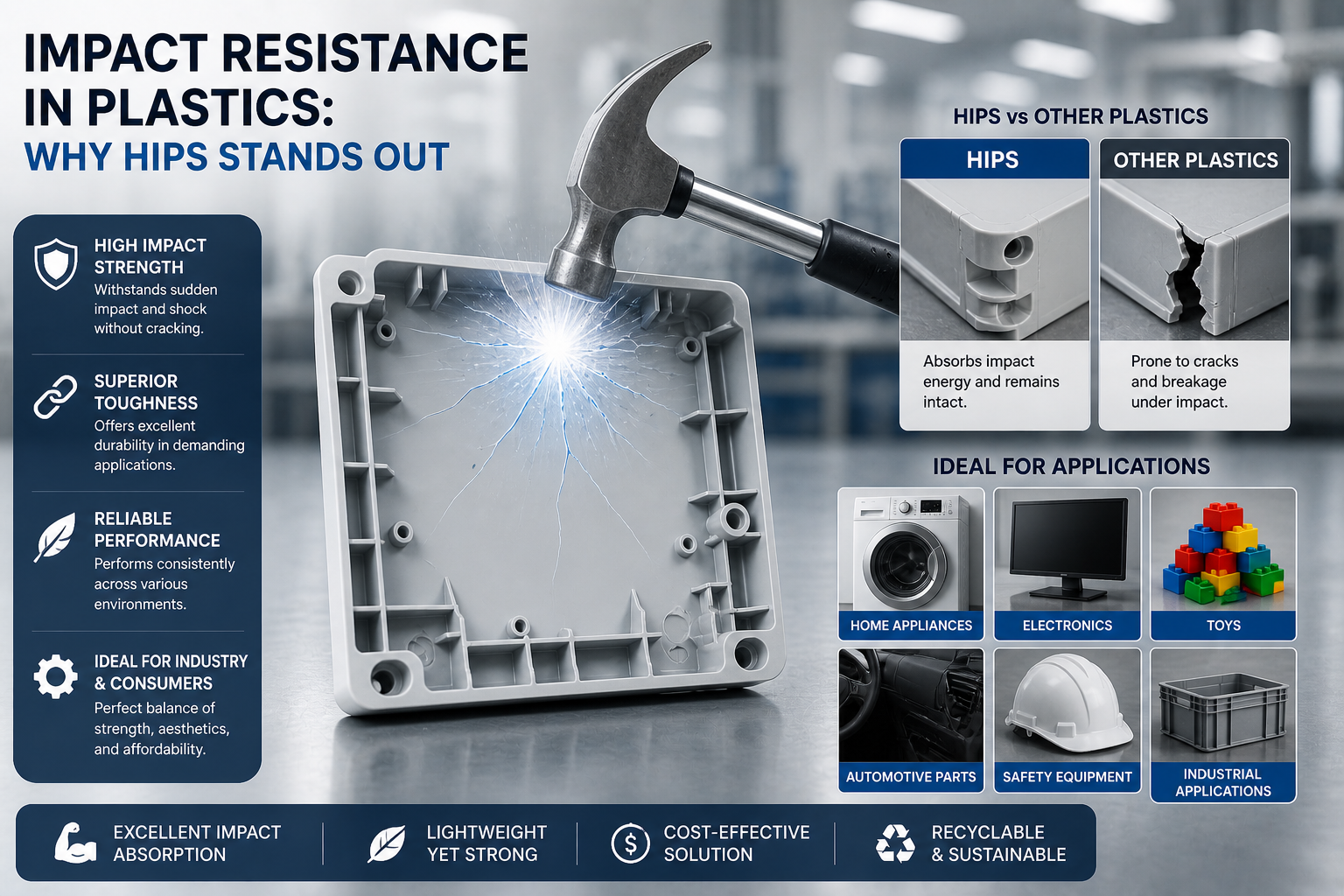
High-impact polystyrene (HIPS) is GPPS modified with polybutadiene rubber. This change creates a two-phase microstructure that dramatically increases impact strength by absorbing and spreading stress energy before it can cause fractures. However, this comes at the cost of transparency; the rubber phase makes HIPS opaque. While HIPS gains toughness, improved gloss, and Environmental Stress Crack Resistance (ESCR), it loses optical clarity. Supreme Petrochem’s HIPS grades offer a range of toughness, gloss, heat distortion temperature, and flow behaviour, allowing manufacturers to select the grade that best meets their needs.
| Property | GPPS | HIPS |
| Appearance | Clear and transparent | Opaque |
| Light transmission | Excellent | Reduced (rubber phase) |
| Impact strength of polystyrene | Lower — brittle under stress | Significantly higher |
| Polystyrene transparency | High — glass-like clarity | Not applicable |
| Toughness | Moderate | High |
| Gloss | Moderate | High (available grades) |
| ESCR (stress crack resistance) | Standard | Enhanced |
| Heat distortion temperature | Moderate | Various grades available |
| Processing methods | Injection moulding, extrusion, thermoforming, blow moulding | Injection moulding, extrusion, thermoforming, blow moulding |
| Typical GPPS industrial applications | Dinnerware, medicalware, stationery, and OPS films | — |
| Typical HIPS industrial applications | — | Appliance liners, electronics, packaging |
GPPS Industrial Applications: Where Transparency Drives Design
The standout feature of general-purpose polystyrene in product design is its outstanding optical clarity. When a design requires consumers to see through the packaging, view contents inside a container, or experience a clean, glass-like material, GPPS is the top choice. Supreme Petrochem offers a variety of GPPS grades, including SC201LV and its water-clear variant, SC201LVLT, each designed for specific processing and clarity needs.
The wide range of GPPS industrial applications shows how many product categories rely on this transparency:
• Refrigerator components: GPPS is used for crisper trays and egg trays, where consumers expect a clean appearance that appears hygienic and premium. The comparison between GPPS and alternative materials consistently favours GPPS for applications requiring visibility and stability at standard refrigerator temperatures.
• Personal care and stationery: Toothbrush handles, containers, ballpoint pen barrels, geometrical instruments, and foot scales utilise GPPS for its clarity, accuracy, and smooth finish. In these categories, aesthetic precision is as important as mechanical function.
• Medicalware: Petri dishes, tissue culture dishes, disposable medical components, and droppers are made from GPPS due to its transparency, stability, and chemical resistance. These mechanical properties make GPPS one of the most popular materials for single-use medical labware worldwide.
• OPS films: Oriented Polystyrene (OPS) films are thin, transparent sheets made by biaxial orientation of GPPS, widely used in food packaging, label films, and display-quality wraps that need high clarity and stiffness.
• Dinnerware: Transparent GPPS cups, plates, and other food-service items cater to markets where clarity, compliance with food safety regulations, and low costs are critical.
What makes GPPS particularly valued by product designers is not just its transparency but also its ease of processing. GPPS is among the simplest thermoplastics to handle consistently through injection moulding, thermoforming, and extrusion. This means designs relying on GPPS can be produced at high volumes without the dimensional issues or surface defects that often arise with more complex materials.
HIPS Industrial Applications: Where Impact Strength Provides Durability
While general-purpose polystyrene shines in optical clarity, high-impact polystyrene excels in durability. HIPS applications are found wherever products need to withstand handling, transport, mechanical stress, and everyday use without failing in appearance or structure over time.
The key features of HIPS that support its industrial use include toughness, gloss, and ESCR:
• Toughness: The polybutadiene rubber in HIPS absorbs impact energy, preventing brittle fractures. This makes HIPS suitable for housing, enclosures, and structural components that must endure handling, drops, or vibrations for extended periods. Consumer electronics, appliance panels, and institutional equipment all count on HIPS impact strength.
• Gloss: Supreme Petrochem’s HIPS grades feature options with high gloss, giving products a premium look even though the material is opaque. High gloss is especially important for consumer electronics, where the surface finish conveys quality. The comparison between HIPS and polypropylene frequently favours HIPS for its gloss and sharp print definition.
• ESCR (Environmental Stress Crack Resistance): HIPS grades with enhanced ESCR are essential for products exposed to cleaning agents, detergents, or other chemicals. Refrigerator inner liners, likely the most common HIPS application in the white goods industry, must maintain integrity through years of exposure to moisture and cleaning chemicals. HIPS with strong ESCR ensure these liners remain functional and visually acceptable throughout the appliance’s lifespan.
A key aspect of HIPS industrial applications is its flexibility in processing methods. Like GPPS, HIPS can be processed using injection moulding, extrusion, thermoforming, and blow moulding. This allows manufacturers who handle both types to use the same processing setup for both materials. Switching between GPPS and HIPS on a production line involves selecting the right material and adjusting parameters, rather than investing in new equipment. This compatibility is one reason why general-purpose polystyrene and high-impact polystyrene are often used together in the same manufacturing facility.
Why Designers Choose General Purpose Polystyrene and High Impact Polystyrene for Consumer Products
From a product design viewpoint, choosing between GPPS and HIPS is not about good versus bad; it is about two different sets of design goals. Knowing when to use each one requires understanding what the product needs to convey to consumers and what it must withstand physically.
General-purpose polystyrene is preferred when clarity is a key requirement. When a product needs to show its contents or feel glass-like rather than plastic, GPPS offers a sensory quality that opaque alternatives can’t match at a similar cost. This is why GPPS is widely used for transparent food containers, laboratory tools, and display-quality packaging. These categories benefit from visual accessibility that enhances consumer trust.
High-impact polystyrene is selected when a design must balance looks with toughness. A glossy, smooth surface on a well-made HIPS part can feel premium, even if it’s opaque, while still providing the strength necessary for the product’s intended use. Products that move through supply chains, change hands frequently, experience temperature fluctuations, or require protection for delicate internal components typically use HIPS. The combination of properties in this material, toughness, gloss, and Environmental Stress Crack Resistance (ESCR) at a processing cost and dimensional consistency similar to GPPS, makes HIPS a common choice for white goods liners, consumer electronics casings, and institutional equipment covers.
Supreme Petrochem’s range of GPPS and HIPS grades provides product designers and manufacturers with the detailed options they need to make informed choices. Instead of a single all-purpose GPPS and a single HIPS, Supreme Petrochem supplies multiple grades in each category. Each grade has a specific profile for clarity, flow, heat distortion, gloss, and impact performance. This means that a manufacturer producing a medical petri dish and another producing a refrigerator liner each select the grade tailored to their specific needs.
How GPPS and HIPS Mechanical Properties Benefit Durable Plastic Manufacturing
For manufacturers operating at an industrial scale, the mechanical properties of GPPS and HIPS offer a significant advantage beyond the performance of individual products. The cost-effectiveness of polystyrene, especially its processing efficiency and dimensional accuracy, has made it one of the most easily scalable thermoplastics across a wide range of production volumes.
Supreme Petrochem produces various grades of general-purpose polystyrene and high-impact polystyrene specifically for injection moulding, extrusion, thermoforming, and blow moulding applications. Having grades designed for each processing method means manufacturers are not using a generic material and adjusting their methods around it. Instead, they work with material formulated for optimal performance under their specific conditions.
From a supply chain standpoint, sourcing from India’s largest polystyrene producer, with a capacity of 300,000 TPA, ensures volume reliability and consistency that smaller suppliers cannot provide. Supreme Petrochem’s product line, which includes GPPS, HIPS, expandable polystyrene, ABS, and compounded grades, allows manufacturers with complex material needs to streamline their supply chains across related materials.
General-purpose polystyrene and high-impact polystyrene are not outdated materials struggling to keep up. They are carefully engineered polymer grades that continue to set the bar for entire product categories, from food-contact labware to consumer electronics casings. Their blend of mechanical performance, processing flexibility, and cost-effectiveness remains unmatched for these specific uses. Understanding where GPPS and HIPS fit into your material selection strategy is one of the best investments a manufacturer or designer can make.
Frequently Asked Questions
The main difference is that HIPS contains polybutadiene rubber. General-purpose polystyrene is unmodified, clear, rigid, and transparent, providing high clarity and good processability. High-impact polystyrene has a rubber component that significantly boosts impact strength, making it much tougher and more durable, but also opaque. GPPS is used when clarity matters, while HIPS is chosen for durability and impact resistance.
GPPS is used in a variety of applications, including medical items (petri dishes, tissue culture dishes, disposables, droppers), stationery (ballpoint pen barrels, geometric instruments), refrigerator components (crisper trays, egg trays), personal care products (toothbrush handles and containers), OPS films for food packaging, and general dinnerware. The qualities of polystyrene, including transparency, dimensional accuracy, radiation stability, and chemical resistance, make GPPS the preferred material in these areas.
HIPS is favoured in white goods and electronics due to three key properties that GPPS lacks: significantly higher impact strength, which protects products during transport and handling; better gloss options that suggest quality on the surface; and Environmental Stress Crack Resistance (ESCR), which helps HIPS maintain its integrity against cleaning agents, moisture, and temperature changes throughout the product’s life. These factors, along with the same processing flexibility as GPPS, make HIPS the top choice in these areas.
Yes, both general-purpose polystyrene and high-impact polystyrene can be processed using injection moulding, extrusion, thermoforming, and blow moulding. This allows manufacturers working with both grades in the same facility to avoid the need for separate processing lines or new equipment investments. Transitioning between GPPS and HIPS is a matter of selecting the right grade and adjusting process parameters rather than changing infrastructure. Supreme Petrochem offers grades of both materials specifically optimised for each processing method, providing manufacturers with the exact mechanical properties they need without compromising their processes.