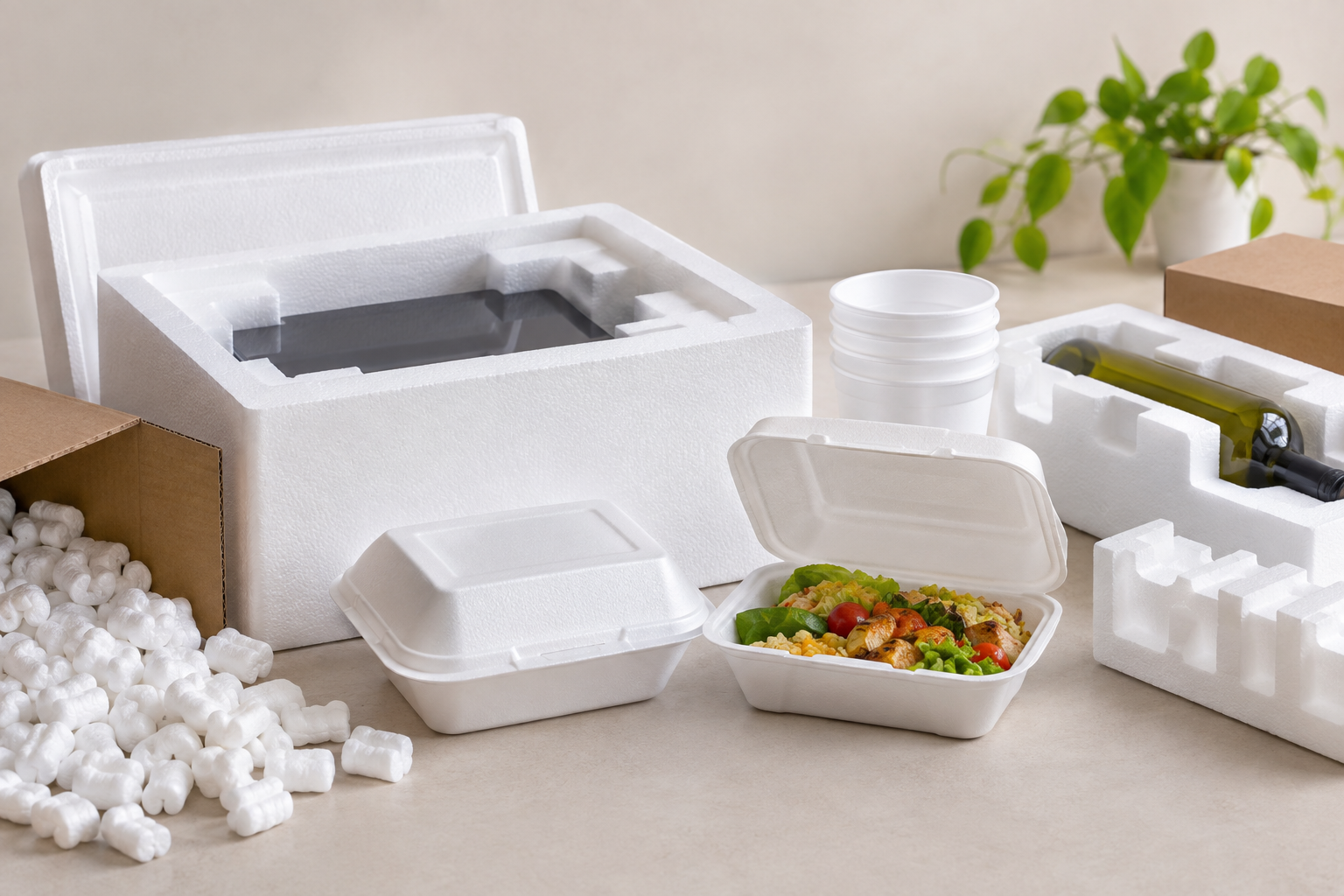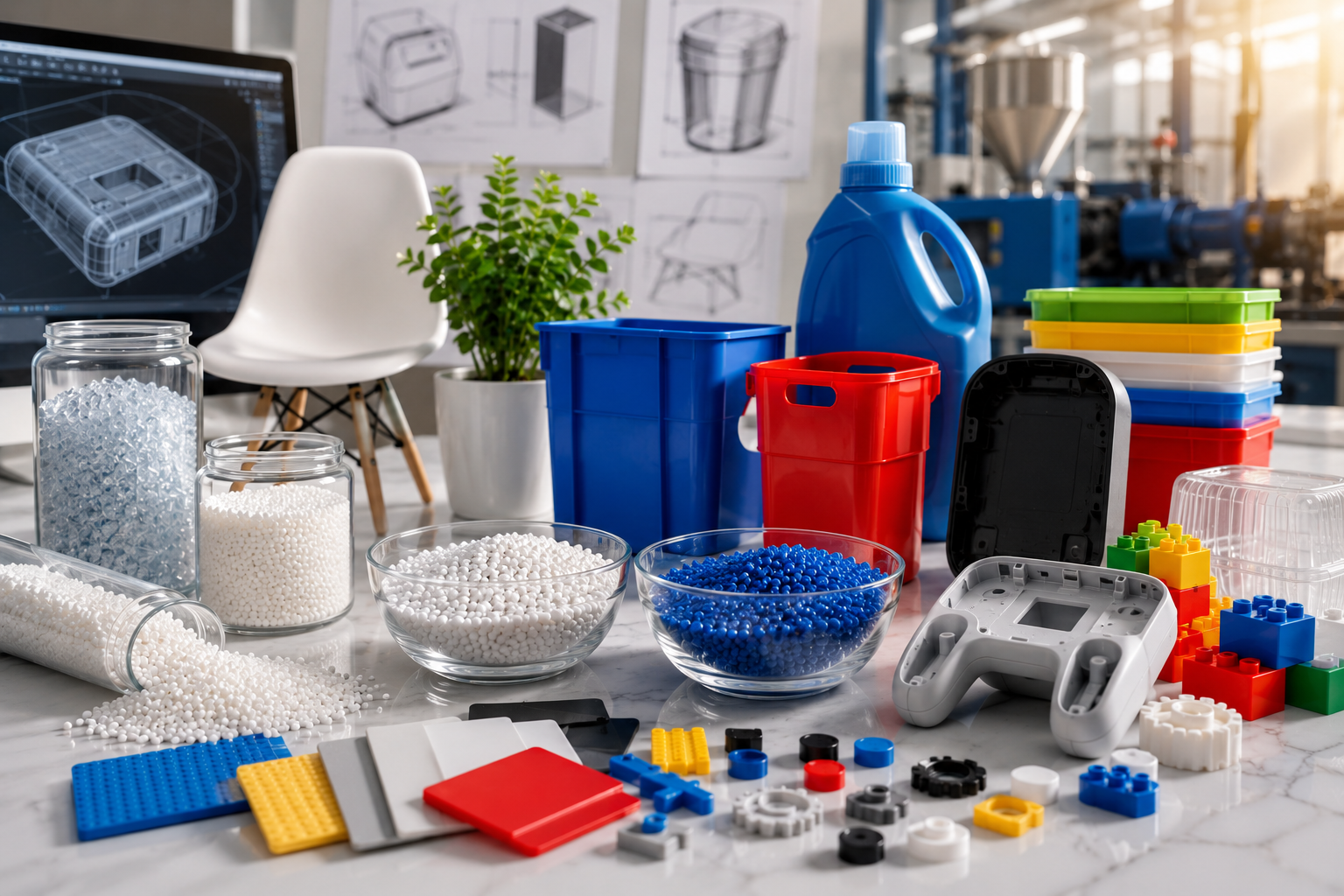
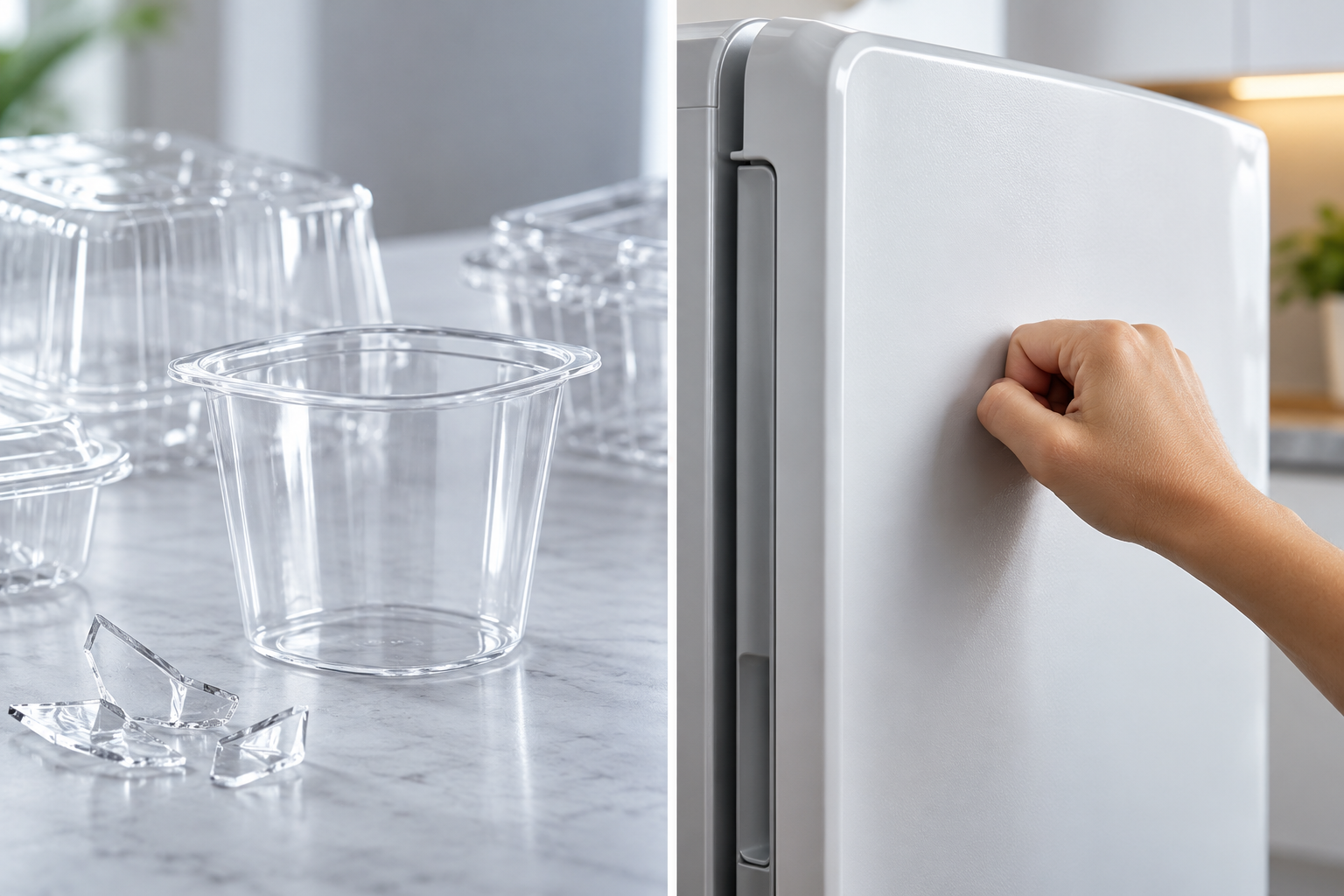
If you pick up the outer casing of a household refrigerator and knock on it, it flexes slightly instead of cracking. Now look at the clear yoghurt pot in the same fridge; if you tap it, it feels rigid and brittle compared to the other one. Both are made from polystyrene, but they behave differently. The difference comes from how each grade is made. Regular polystyrene, known as General-Purpose Polystyrene (GPPS), is the unmodified form. It’s transparent, stiff, and accurately sized. High impact polystyrene (HIPS) is GPPS modified with polybutadiene rubber, which enhances its ability to absorb stress without breaking. Choosing between the two isn’t about which one is better; it’s about which high-impact polystyrene properties and regular polystyrene characteristics best fit a specific application.
In this blog, Supreme Petrochem Ltd, India’s largest polystyrene producer with an installed capacity of 300,000 TPA, explores the differences between high-impact polystyrene and regular polystyrene in detail. We look at how each is produced, what high-impact polystyrene properties make it suitable for demanding uses, where regular polystyrene works well, and how manufacturers in packaging, electronics, appliances, and consumer goods make the right choice between these two versatile grades.
What Is Regular Polystyrene (GPPS) and How Is It Made?
Regular polystyrene, formally called General-Purpose Polystyrene or GPPS, is produced by polymerising styrene monomer, an aromatic compound from petroleum. The result is a hard, transparent, dimensionally stable thermoplastic with no rubber modification. Its polymer chains have an amorphous structure, giving GPPS its optical clarity and rigidity.
The key polystyrene properties that make GPPS valuable for product designers include its glass-like transparency, good chemical resistance, accurate dimensions, and compatibility with all four major processing methods: injection moulding, extrusion, thermoforming, and blow moulding. In applications where customers need to see the product inside the packaging or where a clean, hygienic appearance is key, GPPS delivers a sensory quality that opaque alternatives cannot match at a similar cost.
Supreme Petrochem supplies several GPPS grades, including SC201LV and its water-clear variant SC201LVLT, each designed for specific clarity and flow needs. This allows a manufacturer producing laboratory petri dishes and another making transparent food-service cups to each use a grade that meets their processing conditions and performance requirements.
What Is High Impact Polystyrene and Why Is It Different?
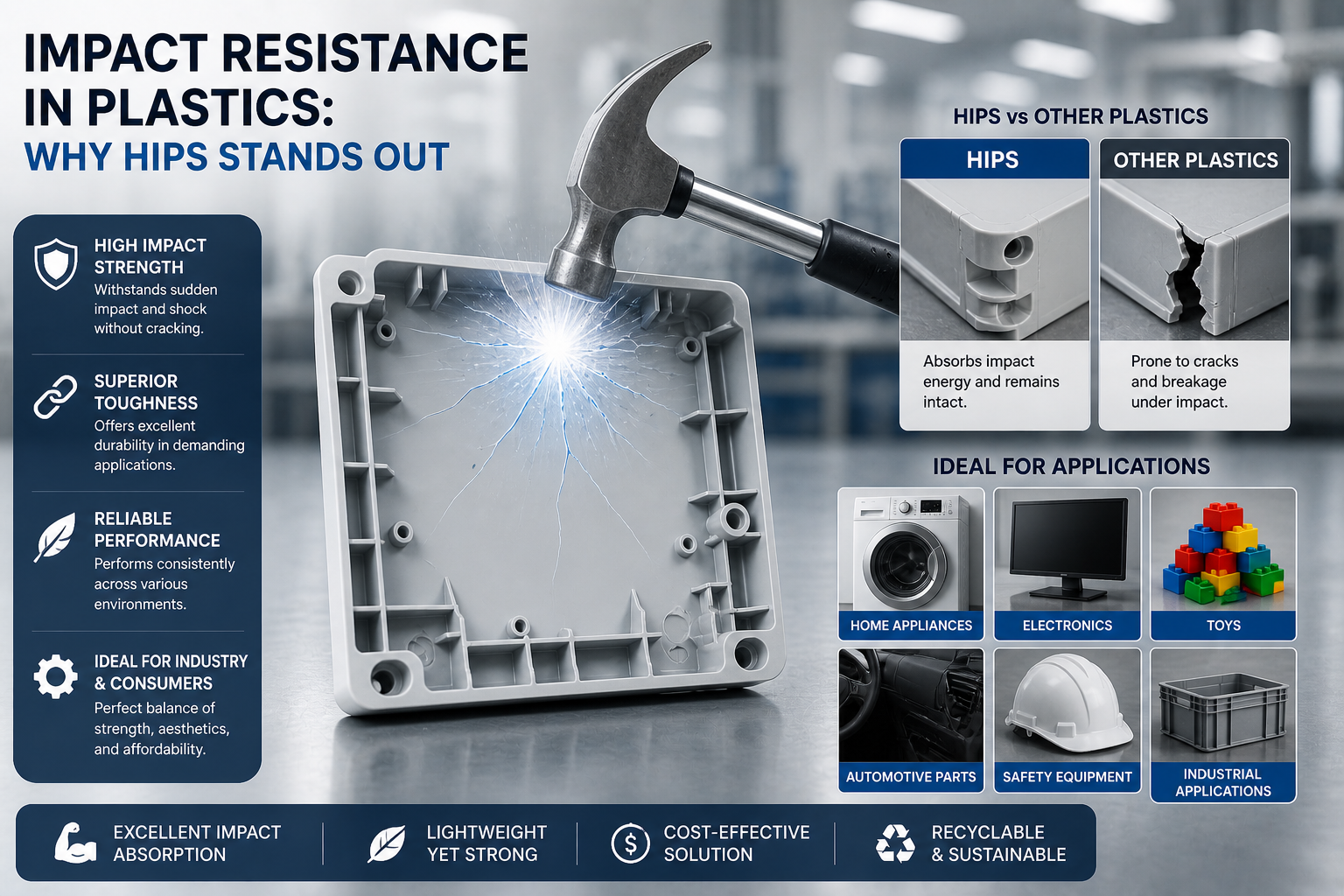
High-impact polystyrene (HIPS) starts as regular polystyrene but is modified during polymerisation with polybutadiene rubber. This creates a two-phase structure, with rubber particles dispersed throughout the polystyrene matrix, serving as energy-absorbing sites when stress or impact is applied. Instead of spreading cracks through a rigid, brittle structure, as standard polystyrene would, HIPS absorbs and distributes that energy, preventing breaks.
This structural change gives HIPS its defining feature: a significantly higher HIPS impact strength than unmodified GPPS. The trade-off is optical clarity; the rubber phase scatters light, making HIPS opaque. However, what HIPS loses in transparency, it gains in toughness, gloss, and Environmental Stress Crack Resistance (ESCR). These properties are essential in applications such as appliance housings, refrigerator liners, electronic casings, and food-service trays that are subject to frequent handling and exposure to cleaning agents.
Supreme Petrochem’s HIPS range includes several grades: SH03, SH300, SH400E, SH400HF, SH400M, SH450, SH731E, and SH2157. Each offers a specific balance of toughness, gloss, flow, and ESCR. This variety allows manufacturers to choose the impact-grade plastic resin designed for their specific conditions.
High Impact Polystyrene vs Regular Polystyrene: A Direct Comparison
The difference between the two grades is best understood by looking at their properties side by side:
| Property | General-Purpose Polystyrene (GPPS) | High-Impact Polystyrene (HIPS) |
| Material family | GPPS | HIPS |
| Appearance | Clear, transparent | Opaque, off-white to grey |
| Optical clarity | Excellent — glass-like | Poor (rubber phase causes haze) |
| Impact strength/toughness | Low — brittle under shock | Significantly higher — tough and ductile |
| Rubber content | None | Polybutadiene rubber added (typically 5–15%) |
| Gloss & surface finish | Moderate gloss, good for transparent parts | High gloss possible (grade-dependent); readily paints and polishes |
| Environmental stress-crack resistance (ESCR) | Standard (lower) | Enhanced |
| Heat distortion temperature | Moderate (varies with grade) | Wide range — some grades offer improved heat resistance |
| Density | Lower | Slightly higher (due to rubber and additives) |
| Processing methods | Injection moulding, extrusion, thermoforming, blow moulding | Injection moulding, extrusion, thermoforming, blow moulding (adjust for rubber dispersion) |
| Typical applications | Medicalware, OPS films, food containers, stationery, display items | Appliance liners and housings, electronic enclosures, packaging trays, toys, and durable consumer goods |
| Mechanical/functional trade-offs | Prioritises optical clarity and stiffness | Prioritises impact resistance, toughness, and paintability |
| Cost & sourcing | Typically, lower cost; widely available | Slightly higher cost; widely available |
| Recycling & sustainability | Recyclable where PS streams exist; clarity helps sorting | Recyclable but mixed/painted parts complicate recycling; label clearly |
A key point often missed is that both grades share the same processing methods. A manufacturer using GPPS and HIPS in the same facility does not need separate production lines. Switching between grades involves selecting the right material and adjusting process parameters, rather than investing in new equipment. This practical advantage significantly boosts efficiency in durable plastic manufacturing.
Key High-Impact Polystyrene Properties That Drive Industrial Demand
Knowing the specific high-impact polystyrene properties that set HIPS apart from standard polystyrene helps manufacturers match the right material to the right application.
Impact Resistance: The polybutadiene rubber in HIPS acts as a polystyrene impact modifier, absorbing and dispersing energy that would otherwise cause brittle fractures in unmodified GPPS. This is the key feature that makes HIPS the preferred material for impact-resistant plastics across consumer electronics, white goods, automotive trim components, and institutional equipment. Items that change hands frequently or are constantly under stress rely on this property.
Gloss and Surface Quality: Supreme Petrochem’s HIPS grades offer high surface gloss, especially SH400E and SH400HF. These grades give finished products a premium look despite being opaque. In consumer electronics, where surface finish communicates quality, this is a crucial difference. HIPS often outperforms other rubber-toughened plastics by combining impact resistance with quality surface finishes that satisfy premium expectations.
Environmental Stress Crack Resistance (ESCR): Products in environments with moisture, cleaning chemicals, or temperature changes, particularly refrigerator liners, must maintain their structural and visual integrity after years of exposure. HIPS grades with enhanced ESCR, such as SH2157, are specifically designed to resist stress cracking when exposed to blowing agents and cleaning agents. This makes them the industry standard for refrigerator cabinet and door liners used by major appliance brands.
Thermoformability: HIPS exhibits excellent thermoformability, making it well-suited for large-surface applications such as refrigerator liners, display boards, and packaging trays. Its ability to form complex shapes with consistent wall thickness and surface quality makes it a top choice for high-volume thermoforming.
Machinability and Colour Acceptance: HIPS accepts colour masterbatches evenly, allowing manufacturers to achieve consistent colour across production runs. It also cuts cleanly, which is useful for retail display materials, signage, and point-of-sale components where precision and colour consistency are crucial.
Where Is High-Impact Polystyrene Used? Industry Applications
The industries that rely heavily on high-impact polystyrene share a common need: a material that combines toughness, surface quality, and ease of processing at a cost that supports large-scale production.
Refrigerators and White Goods: Refrigerator inner cabinets and door liners are among the most demanding HIPS applications in consumer goods. The liner must endure years of exposure to moisture, temperature changes, and cleaning agents, all while maintaining stability and an appealing surface. Supreme Petrochem’s HIPS grades with enhanced ESCR, especially SH2157, are made specifically for this use.
Consumer Electronics: Television cabinets, computer accessories, printer components, air conditioner grilles, and remote-control housings are all made from HIPS. The blend of HIPS impact strength, high gloss options, and easy injection moulding makes this the go-to rubber-toughened plastic for electronic enclosures. Supreme Petrochem’s SH300 and SH450 grades are widely used in this sector.
Food and Dairy Packaging: HIPS extrusion grades, like SH731E, are used for food packaging, including ice cream containers, yoghurt tubs, dairy packaging, and portion cups. These grades combine the polystyrene family’s food-safety profile with the toughness required for distribution and retail handling.
Toys and Consumer Products: Safety, durability, and vibrant colour are crucial for toy components. HIPS meets all three requirements; it’s impact-resistant enough for regular use, takes colour uniformly, and is lightweight, keeping finished products practical. It’s also recyclable, aligning with the increasing sustainability demands in the toy industry.
Automotive Interior Components: Trim panels, interior consoles, and dashboard parts in cost-sensitive vehicles are often made from HIPS. The material is easy to machine, holds its shape well, and offers flexibility in aesthetics. It can also incorporate functional additives, such as flame retardants, making it a good choice for durable plastic manufacturing in automotive applications.
Retail Display and Signage HIPS sheets are widely used for point-of-sale displays, indoor signs, and retail fixtures. The SH2157 grade has a matte finish and prints well, making it especially suitable for this purpose. Printed graphics stick effectively, and the surface finish minimises glare under retail lighting.
When Should You Choose Regular Polystyrene Instead?
Regular polystyrene (GPPS) is the right option when optical clarity is essential in the design or when the application doesn’t need the extra toughness of a rubber-toughened plastic.
Here are the clearest reasons to choose GPPS over HIPS:
• Medical and laboratory ware: Petri dishes, tissue culture plates, droppers, and diagnostic parts need transparency for observation, radiation stability for sterilisation, and chemical resistance to handle lab reagents. GPPS meets all these needs while maintaining low processing costs and high dimensional precision that no opaque alternative can match.
• Transparent food containers: Crisper trays, egg trays, display-quality food-service cups, and OPS packaging films require GPPS’s glass-like clarity. Consumers link transparency to hygiene and freshness, a perceived quality that opaque materials can’t replicate.
• Stationery and personal care: Ballpoint pen barrels, geometric instruments, toothbrush handles, and cosmetic containers use GPPS for its smooth finish, precise dimensions, and clear look.
• OPS films: Oriented Polystyrene films for food packaging, label wraps, and display packaging require the high clarity and stiffness that only GPPS can provide through biaxial orientation.
The key question for any purchasing or design team is simple: Does this application need the consumer or user to see through the material? If yes, choose GPPS. If the application needs toughness, impact resistance, and durability rather than visibility, then HIPS is the appropriate impact-resistant plastic.
How Supreme Petrochem Supports Both GPPS and HIPS Manufacturing
Supreme Petrochem Ltd is India’s largest producer of polystyrene, with a total capacity of 300,000 TPA across manufacturing sites in Nagothane, Maharashtra, and Chennai, Tamil Nadu. The company offers both GPPS and HIPS in various grades, covering all processing methods and application needs in packaging, electronics, appliances, automotive, and medical sectors.
For high-impact polystyrene, Supreme Petrochem’s range spans high-flow injection moulding grades (SH03) to very high-gloss refrigerator liner grades (SH400E), high-flow large-component grades (SH400HF), and the multi-property SH2157. The latter is specially formulated for excellent ESCR, matte finish, and good printability. For standard polystyrene, the GPPS range includes both standard and water-clear grades for applications that need maximum optical performance.
This variety of product options allows manufacturers working across different categories or needing different performance profiles to streamline their polystyrene sourcing with one ISO-certified supplier capable of delivering in large quantities.
Both high-impact polystyrene and regular polystyrene are precision-engineered grades, not generic materials. The difference between them is the presence of a rubber phase that changes brittle clarity into tough opacity. Understanding the specific properties of high-impact polystyrene that make HIPS standard for appliances and electronics, and the optical and chemical properties that keep GPPS the preferred choice for medical and transparent packaging applications, is essential for informed material selection. Supreme Petrochem’s range of both grades, manufactured at scale with consistent quality and technical support, ensures that manufacturers can access the exact grade their application needs.
Frequently Asked Questions
The main difference is the addition of polybutadiene rubber to HIPS during polymerisation. Regular polystyrene (GPPS) is unmodified; it is clear, rigid, and relatively brittle under impact. High-impact polystyrene has rubber particles dispersed throughout its matrix. These particles absorb and diffuse stress energy, greatly increasing HIPS’s impact strength while making the material opaque. GPPS is chosen when transparency is key; HIPS is selected when toughness and durability are more important.
High-impact polystyrene is found in refrigerator inner cabinets and door liners, air conditioner grilles, television and computer housings, food and dairy packaging, toys, automotive interior trim, and retail display materials. Its combination of strength, gloss, ESCR, and ease of processing makes it one of the most widely used impact-resistant plastics in consumer and industrial manufacturing.
Yes. Supreme Petrochem’s HIPS extrusion grade SH731E is made specifically for food packaging, including ice cream containers, yoghurt cups, dairy packaging, and frozen food trays. Polystyrene, as a polymer family, has a solid safety profile for food contact, and food-grade HIPS grades are produced to meet food safety standards. Manufacturers should check compliance with the specific regulations relevant to their market.
Yes. High-impact polystyrene is recyclable through mechanical processes, and advancements in HIPS recycling technology are improving the recovery rate of post-consumer and post-industrial HIPS material. Recycled HIPS can be remade into new impact-resistant plastic applications, contributing to circular economy goals. Supreme Petrochem is actively developing more sustainable HIPS formulations that support higher recycled content and improved recyclability at the end of life.