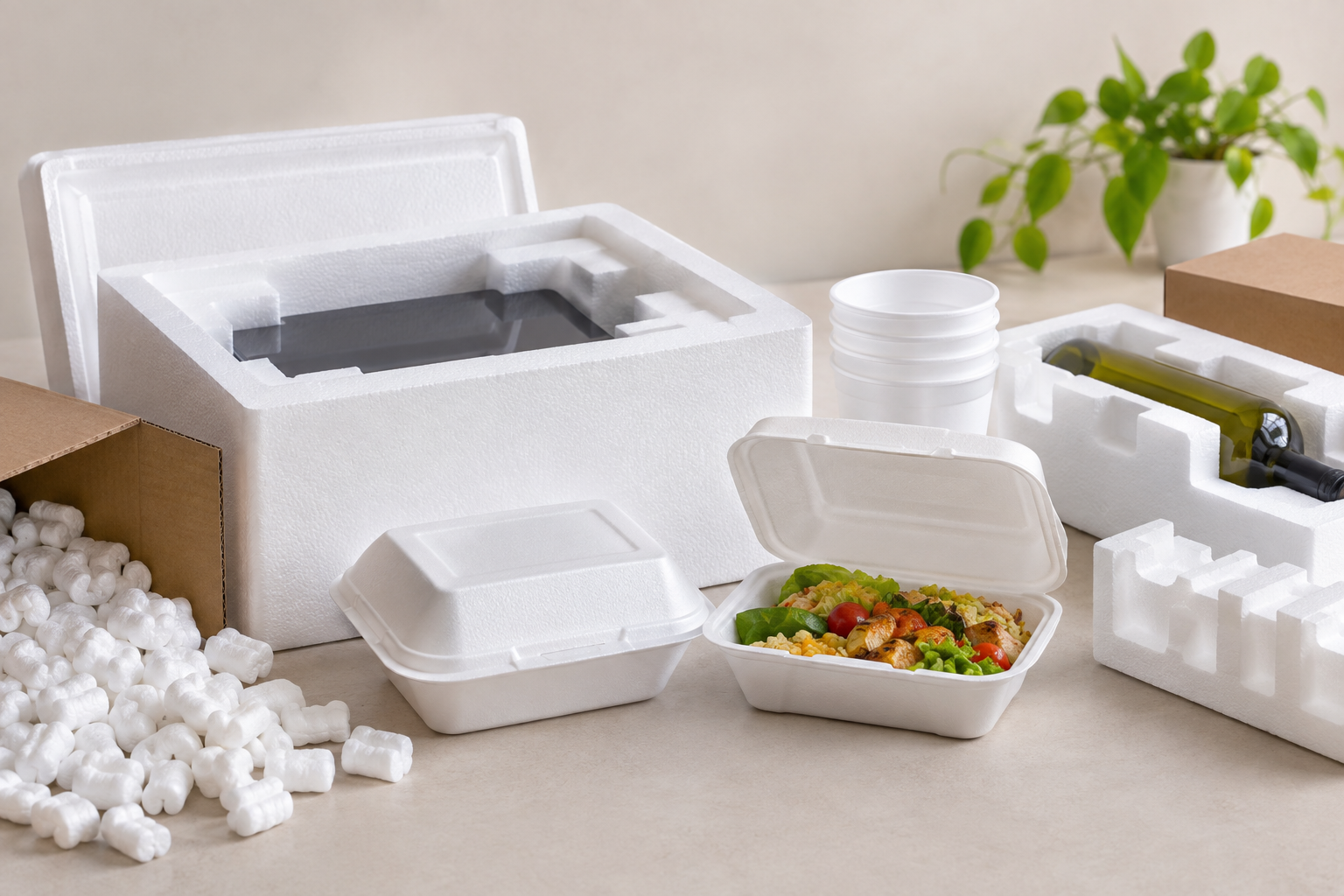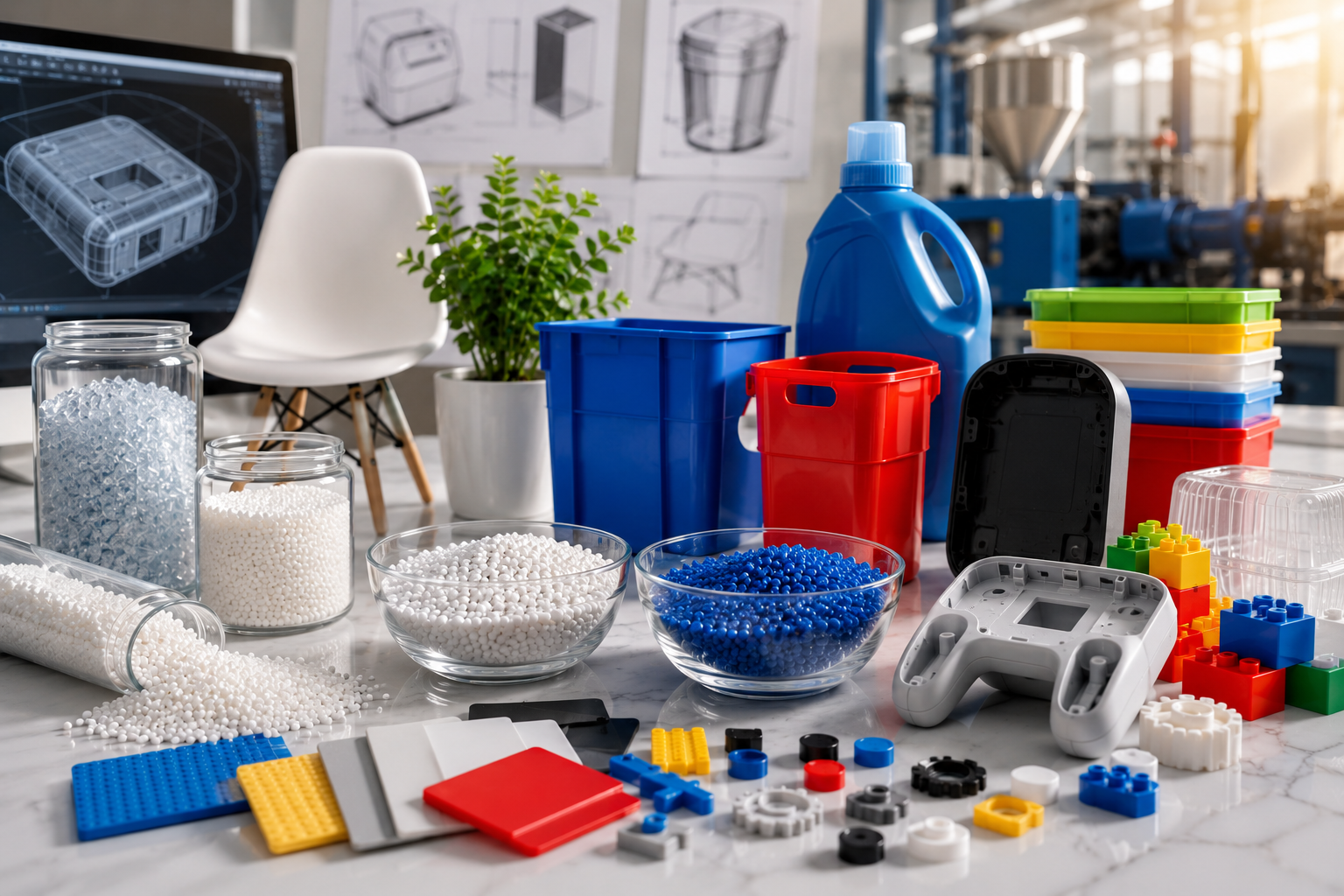
At Supreme Petrochem, we have been manufacturing and supplying both general-purpose polystyrene and high-impact polystyrene for decades, serving customers across packaging, electronics, construction, food service, and consumer goods. In this blog, we examine how these two grades differ in chemistry, polystyrene mechanical properties, polystyrene transparency, processing behaviour, and industrial suitability and explain which grade is right for which application.
Both materials share a styrene backbone and are processed by injection moulding, extrusion, and thermoforming, yet their performance profiles diverge significantly due to a single modification: the introduction of polybutadiene rubber into the HIPS matrix. Understanding this difference, and its consequences for impact strength polystyrene and GPPS industrial applications versus HIPS industrial applications, is what this blog is all about. Supreme Petrochem manufactures multiple grades of both GPPS and HIPS, tailored to the precise requirements of each sector.
What Makes GPPS Transparent — and HIPS Opaque?
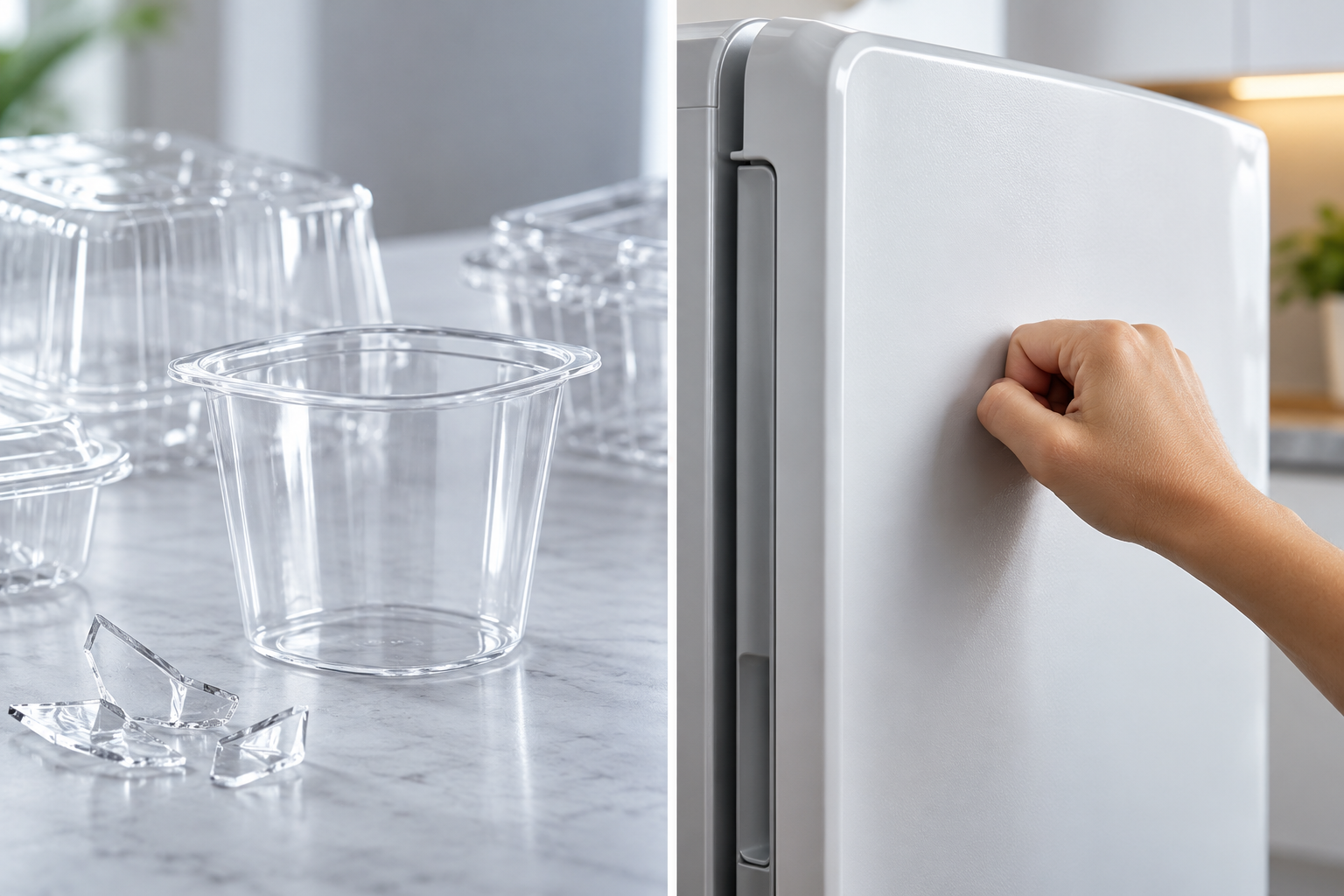
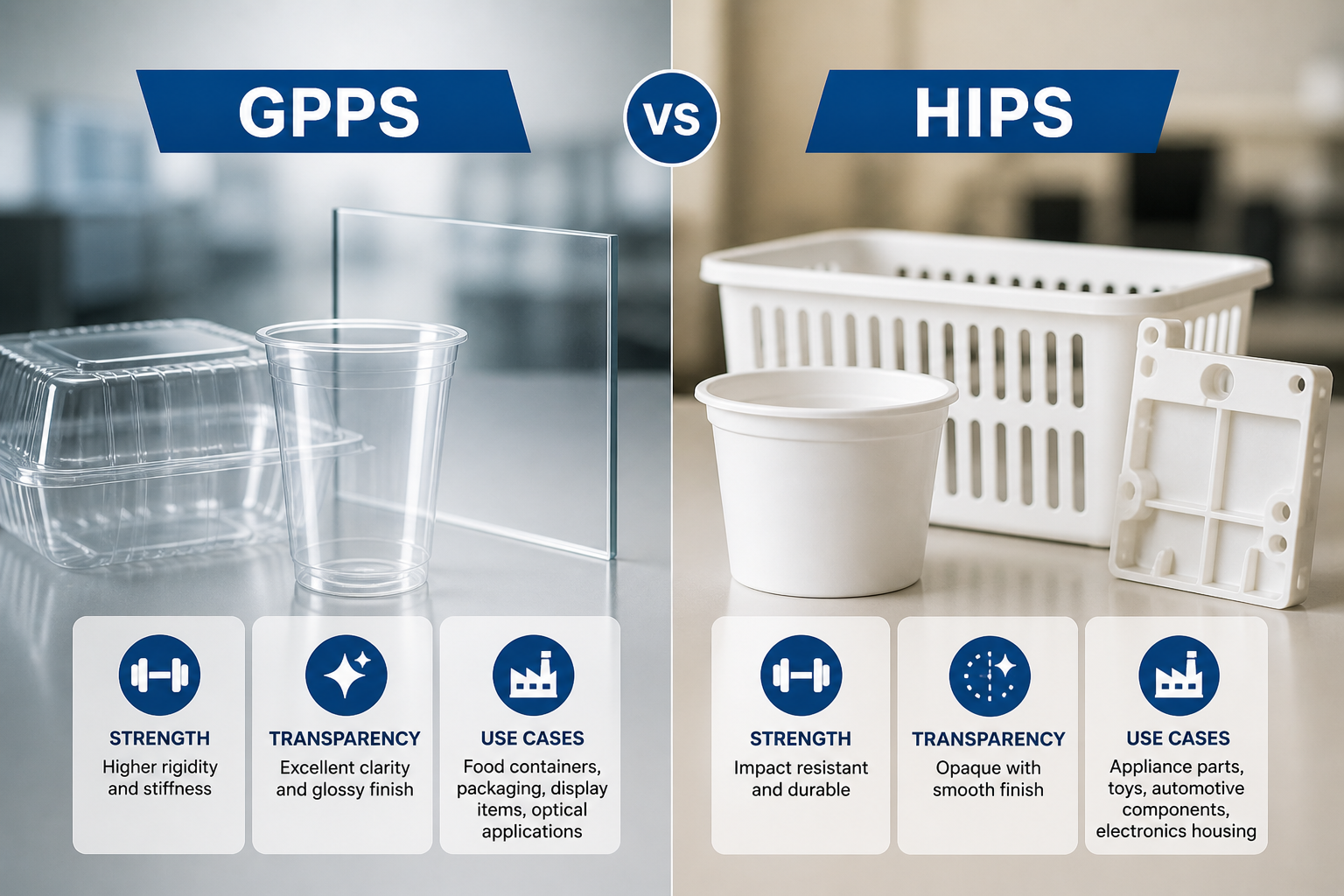
General-purpose polystyrene (GPPS) is the unmodified homopolymer form of polystyrene. It’s entirely uniform, single-phase molecular structure with no secondary particles or inclusions allowing light to pass through without scattering, producing polystyrene transparency of 88–92% and a refractive index of 1.59–1.60. The trade-off is brittleness: the same rigid structure that transmits light fractures under impact with little deformation.
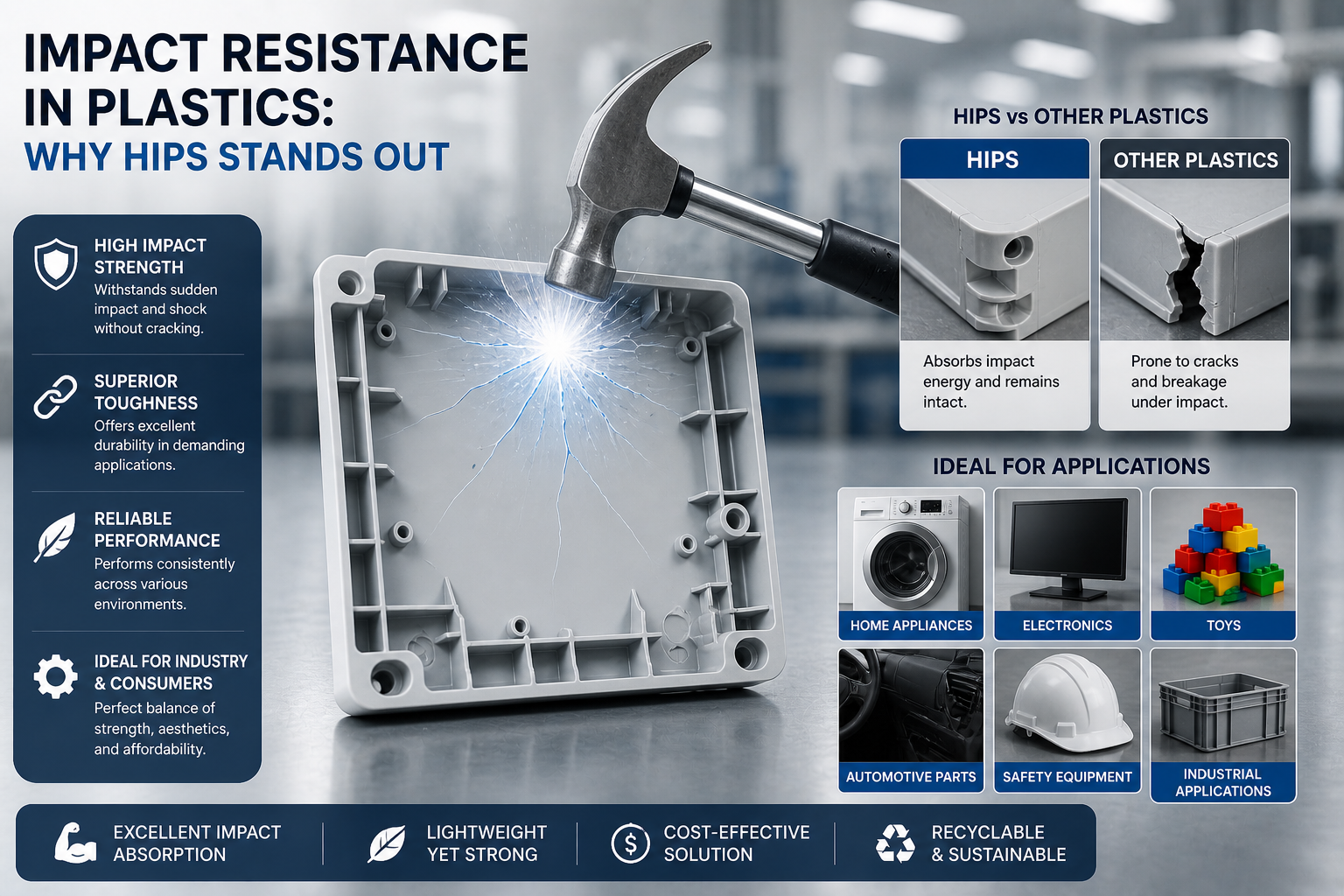
High impact polystyrene (HIPS) is produced by polymerising styrene in the presence of 5–12% polybutadiene rubber. Because polystyrene and polybutadiene are incompatible, the rubber forms discrete microscopic particles distributed throughout the polystyrene matrix, a two-phase structure. Under impact, these rubber particles deform, absorbing energy and arresting micro-crack propagation. HIPS impact strength typically reaches 3–5 kJ/m², far higher than unmodified GPPS. The rubber particles also scatter light at each matrix interface, making HIPS fully opaque: an unavoidable trade-off between toughness and clarity.
Polystyrene Mechanical Properties: GPPS vs HIPS at a Glance
For engineers and procurement specialists, the differences between general-purpose polystyrene and high-impact polystyrene are most usefully expressed through their key polystyrene mechanical properties:
| Property | General-Purpose Polystyrene (GPPS) | High Impact Polystyrene (HIPS) |
| Transparency | Glass-like clarity (88–92%) | Opaque/milky white |
| Tensile Strength | 30–45 MPa | 25–40 MPa |
| Impact Strength | Low (brittle) | 3–5 kJ/m² (significantly higher) |
| Density | 1.04–1.09 g/cm³ | ~1.04–1.05 g/cm³ |
| Rubber Modifier | None | 5–12% polybutadiene |
| Surface Finish | High gloss, transparent | Matte to semi-gloss; printable |
| Processability | Excellent (IM, extrusion, thermoforming) | Excellent (same routes) |
| Typical Cost | Lower | Slightly higher |
| Primary Use | Packaging, display, medical, food service | Appliances, electronics, automotive, toys |
The key observation: both grades are similarly dense and can be processed on the same equipment. The meaningful distinction lies in failure mode: GPPS fractures brittlely; HIPS deforms and absorbs energy before breaking. Grade selection hinges on whether polystyrene transparency or impact strength polystyrene matters most.
GPPS Industrial Applications: Where Clarity and Precision Come First
The GPPS industrial applications profile is built around its two standout attributes: optical clarity and dimensional stability. When a product must display its contents, transparency is commercially essential, and mechanical impact is unlikely, general-purpose polystyrene is typically the most cost-effective option.
Food and beverage packaging: Clear cups, lids, trays, salad bowls, clamshells, and confectionery packaging that deliver glass-like clarity, letting consumers see the product inside and providing a direct retail advantage.
Medical and laboratory: Petri dishes, test tubes, microplates, and diagnostic containers, where sample visibility and ease of sterilisation are functionally essential.
Consumer products and display: CD and DVD jewel cases, cosmetic compacts, transparent storage boxes, pen barrels, and retail packaging all exploit GPPS’s polystyrene transparency and high surface gloss for maximum shelf appeal.
Electrical and electronics: LED light diffusers, lamp covers, and transparent housings that require both light transmission and electrical insulation.
HIPS Industrial Applications: Where Durability Drives Specification
The HIPS industrial applications profile centres on contexts where the product must resist mechanical stress, surface quality matters, and cost efficiency is a commercial imperative.
Consumer appliance housings: Television cabinets, monitor housings, microwaves, blenders, printer casings, and air conditioner covers rely on high-impact polystyrene for the combination of adequate stiffness, impact strength polystyrene, high surface gloss, colour flexibility, and cost efficiency. Supreme Petrochem’s HIPS grades are engineered to serve multinational appliance brands in India and across export markets.
Refrigerator liners: The inner liner of virtually every domestic refrigerator is thermoformed from high-impact polystyrene, requiring excellent deep-draw capability, good environmental stress-crack resistance (ESCR) to cleaning agents and food fats, and long-term dimensional stability at low temperatures. Supreme Petrochem supplies specialist high-ESCR grades for this demanding application.
Toys, stationery, automotive trim, and opaque food packaging: HIPS’s impact strength polystyrene profile, colourability, and printability make it the preferred material for toys, pen barrels, dashboard panels, interior trim, yoghurt cups, ice cream containers, and dairy packaging wherever durability, colour flexibility, and cost efficiency matter more than transparency.
Supreme Petrochem’s GPPS and HIPS: Grades Engineered for Performance
Supreme Petrochem Ltd is India’s largest producer of polystyrene, with a domestic market share exceeding 50% and exports to more than 100 countries. The Nagothane facility in Maharashtra, India’s only international-scale styrenics complex, operates four advanced production lines for general-purpose polystyrene and high-impact polystyrene, supported by a state-of-the-art quality control laboratory and full R&D capabilities. The company manufactures multiple distinct GPPS grades, including options for thin-wall food container moulding, extrusion sheet and thermoforming, and regulatory-compliant medical grades alongside a comprehensive HIPS portfolio covering high-ESCR refrigerator liner grades, high-gloss appliance housing grades, thermoforming grades for food packaging, and colour-consistent grades for consumer goods. Both GPPS and HIPS are available in moisture-proof 25 kg and 900 kg jumbo bags.
The difference between general-purpose polystyrene and high-impact polystyrene is not that one is superior to the other; rather, each excels in a distinct application domain. GPPS delivers unparalleled polystyrene transparency, dimensional stability, and cost efficiency wherever clarity is essential. HIPS delivers superior impact strength polystyrene performance, colour versatility, and surface quality wherever durability is the priority. Understanding their respective polystyrene mechanical properties and the chemistry that drives them is the foundation of sound material selection.
Frequently Asked Questions
In terms of tensile strength, both are broadly comparable: 30–45 MPa for GPPS and 25–40 MPa for HIPS. The decisive difference is impact strength. Impact strength of polystyrene in HIPS reaches 3–5 kJ/m², far higher than GPPS, which fails by brittle fracture. For most practical applications where durability matters, HIPS is the stronger specification because it absorbs energy and deforms rather than shattering under sudden mechanical shock.
Polystyrene transparency in GPPS results from its single-phase, homogeneous molecular structure with no inclusions; light passes through without scattering. High-impact polystyrene contains dispersed polybutadiene rubber particles (5–12% by weight) that differ in refractive index from the polystyrene matrix, scattering light at every interface. This makes HIPS completely opaque, a direct, unavoidable result of the rubber modification that provides its impact resistance.
GPPS industrial applications include clear food packaging, disposable cups and cutlery, laboratory Petri dishes, CD cases, cosmetic containers, LED diffusers, and transparent retail displays. HIPS industrial applications centre on appliance and electronics housings, refrigerator liners, toys, automotive interior trim, and opaque food packaging. Both grades can be produced to food-contact regulatory compliance and are processed by injection moulding, extrusion, and thermoforming.
Choose general-purpose polystyrene when polystyrene transparency is essential, mechanical impact is unlikely, or cost efficiency and clarity are the primary drivers. Choose high-impact polystyrene when the product will be subject to mechanical stress, when opacity is acceptable, or when the surface needs painting, printing, or colour-matching. Supreme Petrochem’s technical team can advise on the optimal grade for your specific processing conditions and performance requirements.