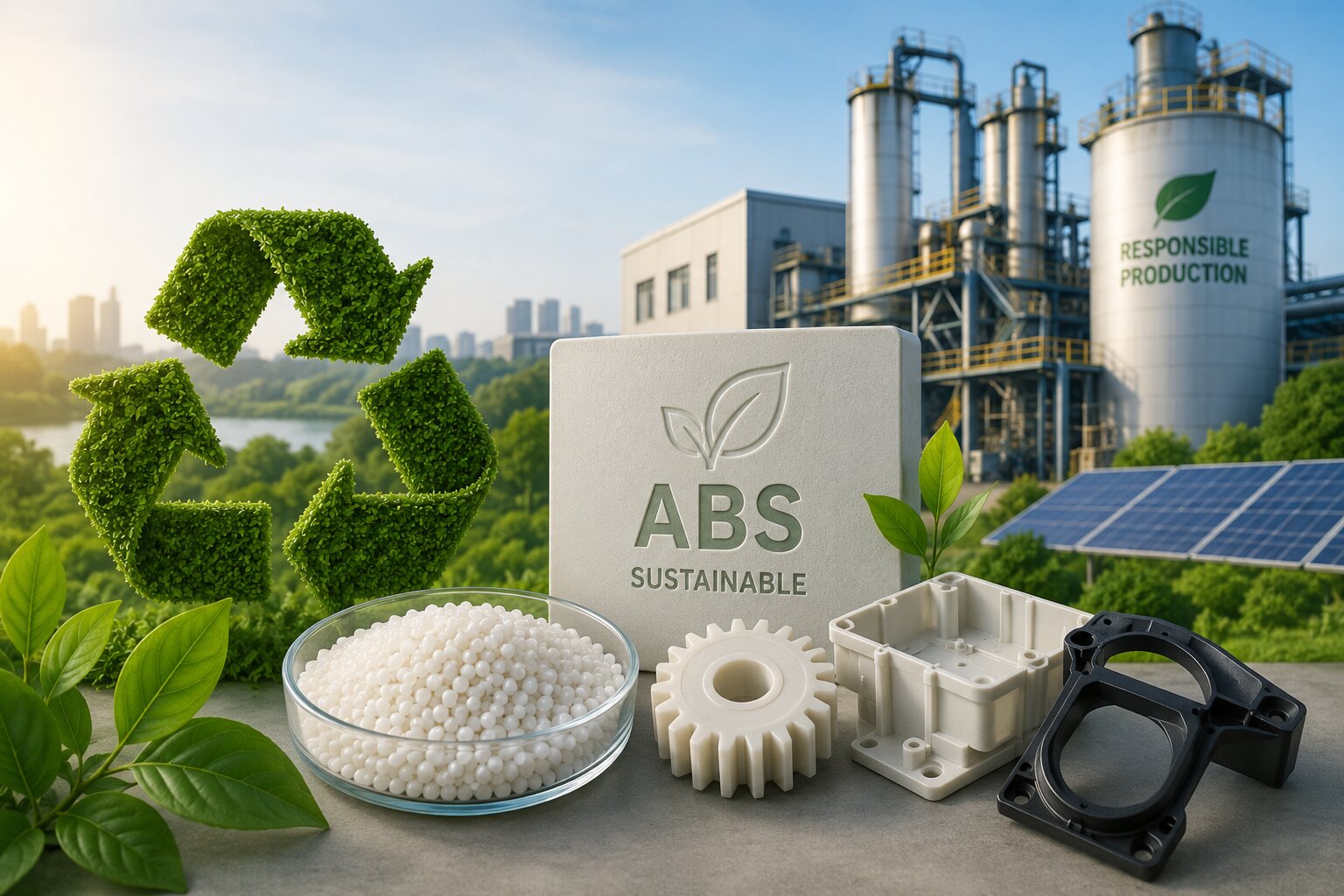
Modern ABS plastic production enhances engineering plastics by reducing carbon footprints through advanced recycling and bio-based feedstocks, thereby addressing the sector’s typical reliance on fossil fuels. As global regulations tighten, these innovations ensure that ABS plastic remains vital for durable applications while supporting net-zero objectives.
Supreme Petrochem, a leading manufacturer of ABS plastic and additive masterbatch manufacturers, discusses these developments in this blog. Find practical insights into polystyrene plastics and ABS compounds that enhance performance while remaining environmentally responsible.
What is ABS Plastic and Its Traditional Environmental Challenges?
ABS plastic, or Acrylonitrile Butadiene Styrene, combines three monomers—acrylonitrile for chemical resistance, butadiene for toughness, and styrene for rigidity—producing a versatile thermoplastic used in automotive parts, electronic casings, and consumer products. Its durability stems from this terpolymer structure, but conventional manufacturing relies on petrochemical feedstocks and energy-intensive polymerisation, and it emits volatile organic compounds (VOCs), contributing approximately 2-3 kg CO₂e per kg produced in outdated facilities.
Historically, ABS plastic has been criticised for its non-biodegradability, with landfill residence times exceeding centuries and microplastic leaching under UV exposure. Modern improvements focus on closed-loop systems, but legacy issues, such as 90-95% reliance on virgin resin, persist in emerging markets.
How Modern ABS Plastic Production Cuts Carbon Emissions?
Contemporary ABS plastic manufacturing utilises electrification and renewable energy, reducing Scope 1 and 2 emissions by 40-50% through the recovery of biomass-derived styrene and solvents. Continuous polymerisation replaces batch methods, lowering energy consumption from 60 MJ/kg to below 40 MJ/kg, while cogeneration captures waste heat for district heating.
Supreme Petrochem demonstrates this at its ISO 14001-certified factories, where ABS compound production is supported by real-time emissions monitoring. Advanced catalysis reduces acrylonitrile waste, and flue gas scrubbing removes 99% of NOx, making the plants low-emission centres.
The Role of Recycling in Sustainable ABS Plastic Production
Mechanical and chemical recycling revitalise ABS plastic, with depolymerisation achieving 95% monomer recovery compared to 70% for virgin methods. Post-consumer waste from white goods—specifically refrigerators, which produce 20% ABS plastic—enters sorted streams, reducing virgin demand by 30% in closed-loop systems.
Dissolution-reprecipitation purifies mixed resins, while pyrolysis converts rejects into oil for re-cracking. Additive masterbatch manufacturers, such as Supreme, improve recyclate with stabilisers, enhancing properties to match prime grades.
| Recycling Method | Yield (%) | CO₂ Savings (kg/kg) | Supreme Application |
| Mechanical | 85-90 | 1.8 | Automotive trims |
| Chemical | 92-95 | 2.6 | Electronics housings |
| Pyrolysis | 75-80 | 2.2 | ABS compounds filler |
Polystyrene and ABS Plastic Synergies for Eco-friendly Engineering
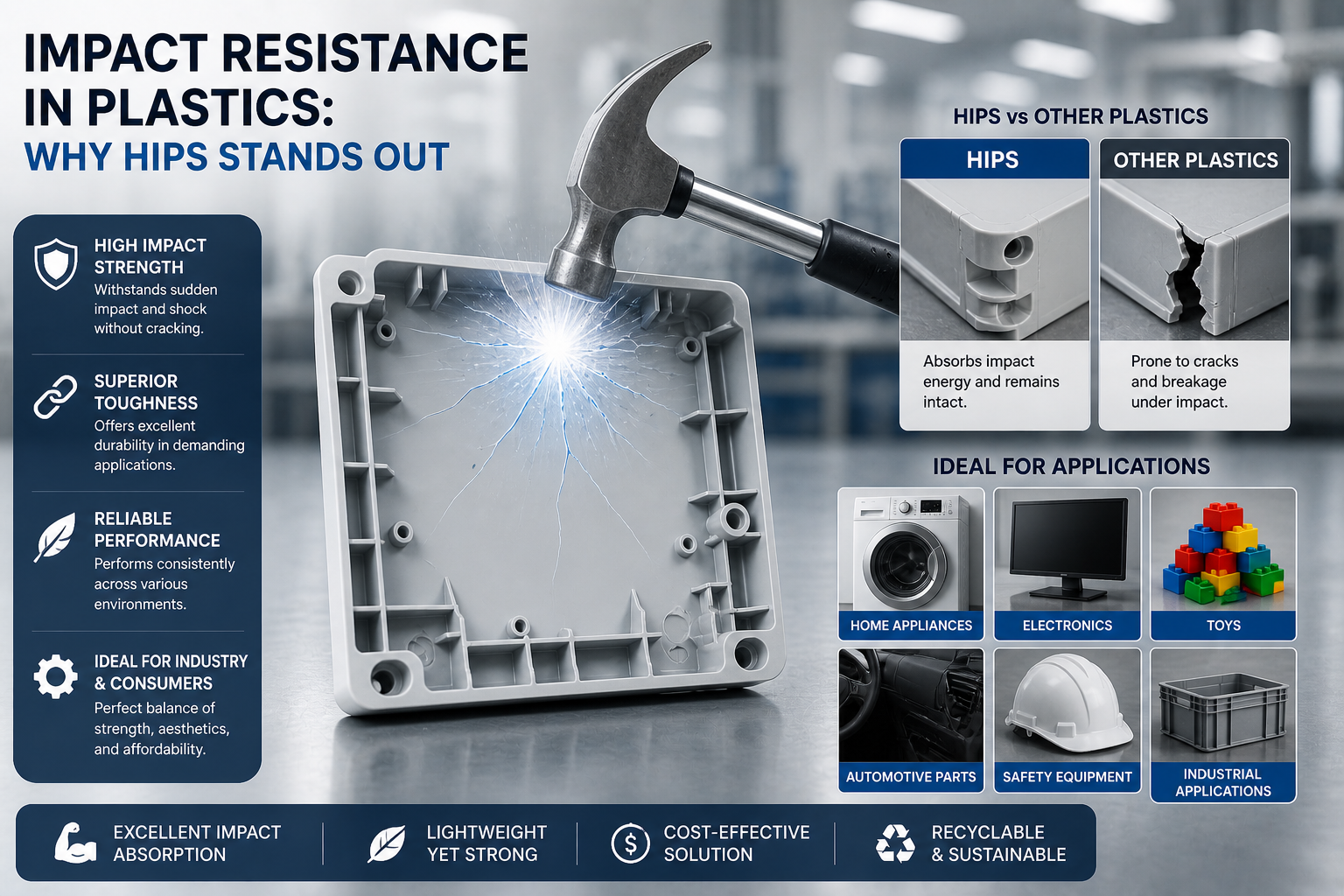
Exceptionally high-impact polystyrene (HIPS) complements ABS in blended compounds by providing cost-effective toughness. Supreme Petrochem offers various grades of polystyrene (PS) for use in hybrid formulations.
Co-extrusion layers of polystyrene barriers on ABS plastic substrates, enhancing recyclability—HIPS separates cleanly via density flotation. This interaction reduces packaging waste, as demonstrated by Supreme’s appliance compounds that meet RoHS directives.
Spotlight: Supreme Petrochem’s Sustainable ABS Compounds and Polystyrene
Supreme Petrochem, India’s leading ABS plastics manufacturers, pioneers eco-engineered ABS compounds at their TPA facilities. Their brochure highlights low-VOC ABS compounds with 25% recycled content, certified by GREENGUARD for indoor air quality
Additive masterbatch manufacturers’ innovations include bio-stabilisers that extend UV life by 50%, reducing replacement cycles. From automotive to E&E, their customised grades prioritise circularity—visit Supreme’s ABS page for specs.
Innovations in Bio-Based Feedstocks for ABS Plastic
Drop-in bio-acrylonitrile made from corn-derived glycerol replaces 30% of petrochemicals, maintaining mechanical properties while lowering dependence on fossil fuels. Styrene produced from sugarcane ethanol is being scaled for commercial production, with pilot plants achieving 1.2 kg of Co₂e per kg, compared with 3.5 kg of naphtha routes.
Bio-variants of butadiene produced through fermentation lag behind commercially available ones but provide a 50% reduction in GHG emissions. ABS plastic manufacturers blend these at 20-40% and obtain certification under ISCC PLUS for mass balance.
Step-by-step adoption framework:
Certify under the EU Taxonomy for green financing.
Assess application tolerances via ASTM D256 impact tests.
Source ISCC-certified monomers from suppliers like Supreme.
Validate via LCA using ISO 14040.
Scale with masterbatch dispersions.
Energy Recovery and Circular Economy in Polystyrene Plastic Processing
Polystyrene plastic waste-to-energy through gasification produces syngas for steam cracking, closing the loop for ABS plastic monomers. Supreme Petrochem primarily focuses on recycling post-consumer Expanded Polystyrene (EPS) waste into new products through partnerships, rather than converting it into energy recovery.
Pyrolysis oil is refined into BTX aromatics, which are used as feedstock for styrene—1 tonne of PS produces 700 litres of oil. This replaces 1.5 tonnes of virgin naphtha, according to 2023 EU studies.
Pros of circular polystyrene:
- 80% virgin reduction.
- Zero landfill.
- Revenue from waste streams.
Cons: Sorting purity (95% required); initial capex.
Regulatory Pressures Leading ABS Plastic Sustainability
The EU’s PPWR mandates 25% recycled content in plastics by 2025, increasing to 30% by 2030, pushing ABS plastic manufacturers to scale up in compliance with India’s PWM Rules 2022 EPR mandate, with the Supreme Court leading compliance through traceable resins.
The Carbon Border Adjustment Mechanism taxes imports with high carbon intensity, favouring low-carbon ABS compounds. REACH SVHC listings on butadiene stimulate stabiliser innovations.
Compliance checklist:
- EPR portal registration.
- Annual recycled content reporting.
- Third-party LCA audits.
- VOC emissions <50 mg/m³.
Life Cycle Assessment: Measuring Reductions in ABS Plastic Footprint
Cradle-to-gate LCA indicates that modern ABS plastic emits 1.8 tCO₂e/t, a 45% reduction compared to 1990s levels. Use-phase durability doubles its lifespan and disperses its impact.
End-of-life recycling credits deliver a net -0.5 tCO₂e per tonne; tools such as the GaBi model guide additive masterbatch manufacturers’ formulations.
| Lifecycle Stage | Traditional (tCO₂e/t) | Modern (tCO₂e/t) | Improvement |
| Feedstock | 2.1 | 1.2 | 43% |
| Production | 1.4 | 0.6 | 57% |
| Use | 0.5 | 0.3 | 40% |
Challenges and Future Directions for Sustainable ABS Plastic
Scalability limits bio-feedstocks to under 5% of the market; sorting technologies such as AI spectrometers achieve 98% purity. Cost premiums (10-20%) hinder widespread adoption, but subsidies help offset these costs.
Future: Enzymatic depolymerisation for 99% recovery; lignin-based butadiene pilots. Supreme Petrochem invests in R&D for 50% bio-content ABS compounds by 2030.
Sustainability in engineering plastics is advancing rapidly, with modern ABS plastic production at the forefront in reducing environmental impact through recycling, bio-feedstocks, and enhanced efficiency. Supreme Petrochem’s leadership in ABS compounds, polystyrene, and masterbatches sets industry standards, helping industries move towards circularity while providing exceptional durability.
Frequently Asked Questions
Modern, sustainable ABS plastic is more eco-friendly than traditional ABS because it incorporates recycled or bio-based materials and leverages advances in recycling technologies. Traditional ABS is non-biodegradable, relies on fossil fuels, and presents environmental issues during production and disposal.
Polystyrene (PS), specifically high-impact polystyrene (HIPS), is integrated with acrylonitrile-butadiene-styrene (ABS) primarily in the recycling of electronic waste (WEEE) to achieve environmental benefits by enabling high-value reuse of mixed plastic waste streams and reducing dependence on virgin materials.
Yes, ABS compounds from additive masterbatch manufacturers are generally recyclable. The presence of common additives in masterbatches does not inherently prevent the material from being recycled. However, the specific process and quality of the recyclate depend heavily on the type and concentration of these additives.
No, current ABS plastic production generally does not align with 2030 net-zero targets under baseline scenarios. The production process remains a significant source of greenhouse gas (GHG) emissions, and global production trends are continuing to rise.